Courses
- Abaqus
Full Course: Low-Velocity Impact
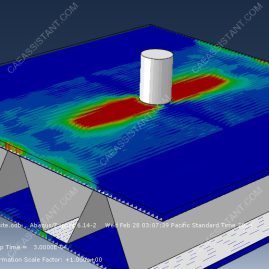
Read moreLow-velocity impact refers to the collision between objects at relatively low speeds. While the impact energy may be lower compared to high-speed impacts, low-velocity impacts can still cause significant damage and deformation. Assessing the effects of low-velocity impact is crucial for various industries to ensure the structural integrity, safety, and performance of their products. For example, in the automotive industry, understanding the response of vehicles to low-velocity impacts is essential for designing crashworthy structures and improving occupant safety. In aerospace, assessing the impact resistance of aircraft components, such as fuselage panels or wings, helps ensure their ability to withstand ground handling incidents or bird strikes. In this package, you will learn how to do low-velocity impact simulations with several practical examples.
- Abaqus
Full Course: Dam simulation
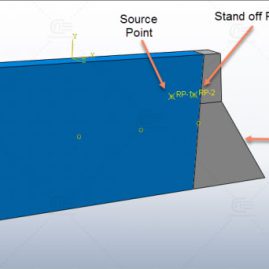
Read moreA dam is a large concrete or earthen barrier built across a river or other waterway to create a reservoir for storing water. Dams are critical infrastructure for providing water for irrigation, drinking, and hydroelectric power generation. However, they are also susceptible to damage from natural disasters and human-made threats, such as earthquakes, landslides, and terrorist attacks. Abaqus can predict the behavior of dams under different loading conditions, including earthquakes, floods, and explosions. It also can model the interaction between the dam, water, and soil, making it a comprehensive and powerful tool for dam engineering. In this package, you will learn how to model dams in different conditions, such as dam simulation subjected to earthquakes in interaction with water and soil and dam simulation subjected to an underwater explosion.
- Abaqus
Full Course: Mohr-coulomb usage
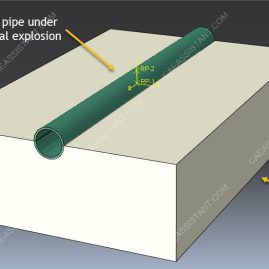
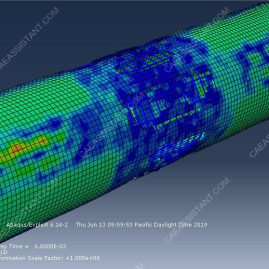
Read moreA mathematical model called the Mohr-Coulomb theory describes how brittle materials, such as concrete or rubble piles, react to both shear stress and normal stress. This rule is followed by the majority of traditional engineered materials in at least some of their shear failure envelope. In this package, you will learn how to use this theory in four practical examples: Analysis of surface explosion damage to an underground box tube in ABAQUS, dynamic analysis of a tunnel in soil subjected to internal blast loading, An internal explosion-related numerical simulation of the behavior of a pipeline’s damage mechanics, and for cases utilizing crashworthiness, simulate an Eulerian method to soil impact analysis.
- Abaqus
Full Course: CFD Analysis
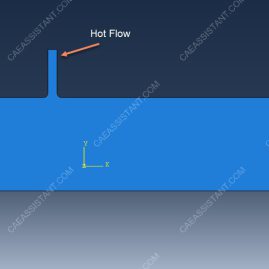
Read moreFluid-Structure Interaction also known as FSI is a multiphysics problem where the fluid and structure are coupled. The fluid flow can cause the structure to deform, and the deformation of the structure can affect the flow. So when you want to design something, you need to know how the structure will deform and how that deformation affects the flow. Common examples of FSI analysis are airplanes, cars, spacecrafts, and buildings. Other examples like junctions in piping systems, or the human circulatory system. CFD is a branch of research that uses numerical methods to solve the mathematical equations governing fluid flow, heat transfer, mass transfer, chemical reactions, and related phenomena. In Abaqus, you can model both methods. In this package, we present to you three workshops to get you started with Abaqus CFD and FSI: “Using Abaqus CFD methods, examining heat mixing and reverse flow characteristics in a T-junction”, “impact of air velocity over the short column”, “simulate fluid structure interaction on an aluminum body with a flexible tail in Abaqus”.
- Uncategorized
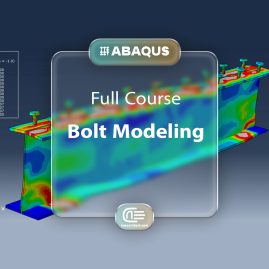
Full Course: Bolt Modeling
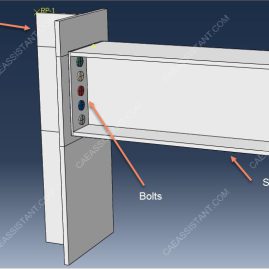
Read moreBolts and joints play a vital role in the stability and structural integrity of various engineering structures, including buildings, bridges, and machines. Bolts are used to fasten or connect different components together, providing a means of transferring loads and ensuring the continuity of load paths. Joints connect structural elements, allowing them to move and deform while maintaining their overall stability. Proper design and selection of bolts and joints are crucial to ensuring the safety and durability of the structure. Factors such as the type of load, the materials used, and the environmental conditions must be considered when selecting bolts and joints. Failure to properly design and install bolts and joints can result in catastrophic failure of the structure. In this package, you will learn how to model bolts and joints, simulating the failure of connections and other things with practical examples.
- Abaqus
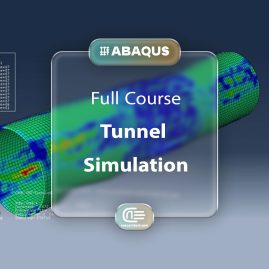
Full Course: Tunnel Simulation
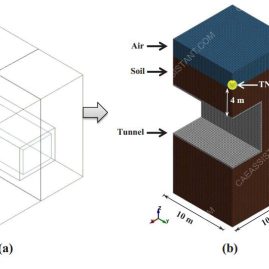
Read moreA tunnel is an underground or underwater passage for transportation, utility lines, or water pipelines. Tunnels are critical infrastructure, and their safety and reliability are essential for ensuring public safety and the smooth functioning of society. Tunnel simulation involves using computer models to predict the behaviour of tunnels under different types of loading conditions, such as earthquakes, floods, or explosions. These simulations can help engineers and policymakers assess the safety and reliability of tunnels, identify potential failure modes, and develop strategies to mitigate risks. By using advanced simulation techniques, engineers can better understand the complex behavior of tunnels and design more effective and durable structures. Tunnel simulation is an essential tool for ensuring the safety and resilience of tunnels and the infrastructure they support. Some workshops are presented in this package to teach you how to simulate and analyze tunnels in Abaqus; two of these workshops are Damage analysis of an underground box tunnel subjected to surface explosion and Tunnel dynamic analysis subjected to internal blast loading using CEL method.
- Abaqus
Full Course: Cold spray simulation
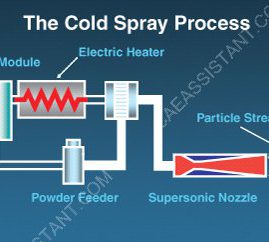
Read moreCold spray is a process used to deposit materials onto a substrate by accelerating fine powder particles to high velocities using compressed gas. Upon impact with the substrate, the particles undergo rapid plastic deformation, disrupting surface oxide films and promoting bonding between metal surfaces. Unlike thermal spray processes, cold spray avoids thermal degradation and partial oxidation of the coating material, resulting in coatings with low porosity and oxygen content. The process is highly efficient, with deposition efficiencies often exceeding 90%. Shot peening is a metal treatment process that involves bombarding a surface with small, round metallic (usually steel), ceramic, or glass beads at high velocity. This process creates small indentations on the surface, which in turn introduces compressive residual stress into the material. These two processes are different and use for separate purposes but their simulations are the same.
Cold spray is particularly important in applications where thermal degradation or oxidation of the coating material is a concern or where the coating is required to be thick and free from defects. In this package, you will learn how to simulate this process with different methods, such as ALE and SPH, with different materials. For example, Cold spray simulation of steel particles impacts on the Inconel target using ALE method.
- Coupled Fields & Dynamics
Full Course: Acoustic simulation
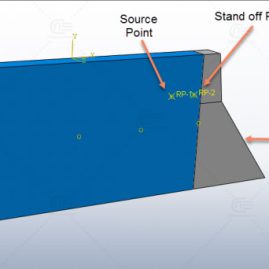
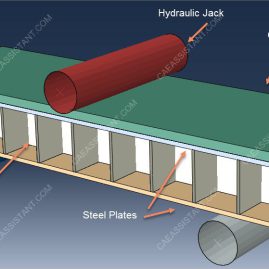
Read moreThe study of mechanical waves in gases, liquids, and solids, including issues like vibration, sound, ultrasound, and infrasound, is the focus of the physics subfield of acoustics. A shock wave is a sort of disturbance that propagates across a medium faster than the local speed of sound. In industry, we use acoustic loading in cases such as hydraulic forming, SONAR, seismology, acoustic emission, vibration analysis, engine testing, etc. In this package, you will learn how to model acoustic loadings and shock loadings in four workshops: Deformation behavior of a stiffened panel subjected to underwater shock loading, Acoustic method-based numerical simulation of the electro-hydraulic forming process, Failure modes of concrete gravity dams simulation exposed to an underwater explosion, and Simulation of hull Coupled acoustic-structural response subjected to an underwater explosion.
- Abaqus
Full Course: Eulerian Modeling in Abaqus
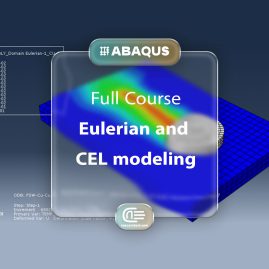
Read moreThe Eulerian method is a numerical technique used to analyze fluid mechanics problems. In this approach, the fluid is treated as a fixed grid, where the nodes remain stationary while the fluid flows through them. The Eulerian Abaqus method can be used to analyze fluid-structure interactions, such as fluid impact on structures or the behavior of fluids in containers. To use the Eulerian method in Abaqus, the desired geometry must first be meshed using Eulerian elements. The material behavior of the fluid is then defined using appropriate equations of state. Finally, the boundary conditions and loading are applied, and the system is solved using the appropriate numerical method, such as the finite element method. This package will teach you how to use this method and various practical examples. Also, this package covers several practical examples in Abaqus CEL method.
- Abaqus
Full Course: Johnson-Holmquist damage model
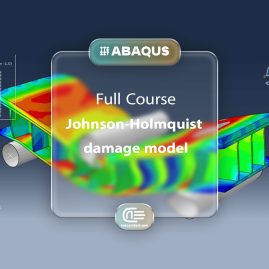
Read moreThe Johnson-Holmquist damage model is used in solid mechanics to simulate the mechanical behavior of damaged brittle materials over a range of strain rates, including ceramics, rocks, and concrete. These materials typically exhibit gradual degradation under load due to the development of microfractures and typically have high compressive strength but low tensile strength. In this package, there are 13 practical examples to teach you how to use this damage model. The workshops are categorized into Ceramic materials, concrete, glass materials, and others.
- Abaqus
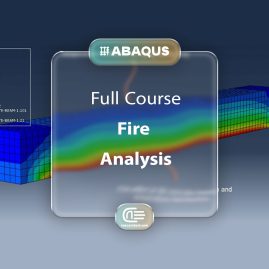
Full Course: Fire Analysis
Read moreThe aim of fire analysis is to evaluate the performance of structures in real fire scenarios and to develop strategies to improve their fire resistance and safety. Fire analysis is commonly used in the design and evaluation of buildings, bridges, and other structures. Fire analysis is the process of simulating the behavior of structures under fire conditions. Fire analysis typically involves two main steps: (i) heat transfer analysis to estimate the propagation of heat in the structure and (ii) structural analysis taking into account the effects of heat and mechanical loads. In this package, you will learn how to do a fire simulation on some structures and parts like concrete beams. You can find more details about how to do this simulation in the description of the workshops.
- Abaqus
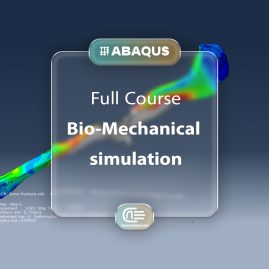
Full Course: Bio-Mechanical
Read moreThis video tutorial package offers a comprehensive guide to biomechanical simulations using Abaqus, covering a range of applications from dental to orthopedic and cardiovascular analyses. The workshops delve into finite element method (FEM) simulations, exploring static loading on human teeth, crack growth in bones under bending, bone drilling, and the behavior of titanium foam implants. Each tutorial emphasizes the importance of precise modeling and meshing techniques, utilizing dynamic explicit procedures, Johnson-Cook material models, and various contact and boundary conditions to simulate realistic biomechanical behaviors. Additionally, the package includes fluid-structure interaction (FSI) simulations for blood flow within coronary vessels, addressing both Newtonian and non-Newtonian models, and demonstrates the integration of computational fluid dynamics (CFD) with structural analysis for enhanced accuracy. The lessons complement the workshops by introducing fundamental FEM concepts, solver selection, explicit analysis considerations, and damage modeling, ensuring users gain a solid understanding of both theoretical and practical aspects of biomechanical simulations in Abaqus.
We also offer a similar budget-friendly package that includes all the workshops from this package. However, since it does not include the lessons, it is available at a lower price. You can purchase it on our website at a more competitive rate than similar platforms.
- Abaqus
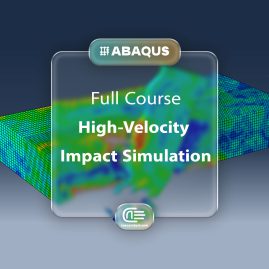
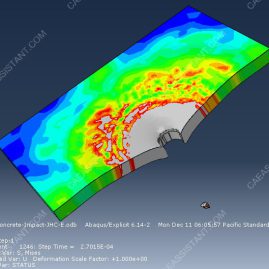
Full Course: High-Velocity Impact
Read moreHigh-velocity impact refers to the collision between two bodies at extremely high speeds, typically involving projectiles and targets. It is a phenomenon of great interest in various fields, including defense, aerospace, and automotive industries. High-velocity impact simulation in Abaqus is a computational approach used to analyze and predict the behavior of materials and structures subjected to such impacts. Abaqus, a powerful finite element analysis software, enables engineers and researchers to model and simulate the complex interactions between impacting bodies, accurately predicting factors like stress, strain, deformation, and damage. By simulating high-velocity impacts in Abaqus, engineers can gain valuable insights into the performance and integrity of materials and structures, ultimately aiding in the design of safer and more resilient systems. In this package, you will learn how to do these simulations in many practical examples.