Manufacturing Processes
- Abaqus
Full Course: Hydroforming simulation
Read moreHydroforming is a metal forming process that allows the shaping of various metals, such as steel, stainless steel, copper, aluminum, and brass. It is a cost-effective and specialized form of die molding that utilizes highly pressurized fluid to shape the metal. Hydroforming can be classified into two main categories: sheet hydroforming and tube hydroforming. Sheet hydroforming uses a single die and a sheet of metal, while tube hydroforming involves expanding metal tubes using two die halves. Hydroforming simulation in Abaqus is a valuable tool for optimizing the hydroforming process. It enables engineers to predict and analyze important factors such as material flow, stress distribution, thinning, and wrinkling during the forming process. By accurately simulating the hydroforming process, engineers can optimize key parameters like fluid pressure, die design, and material properties to achieve the desired shape with minimal defects. In this package, you will learn hydroforming process simulation with the SPH method and using time-pressure curve.
- Abaqus
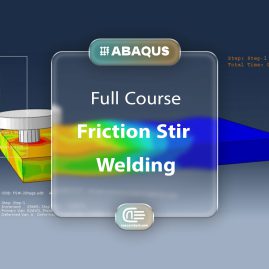
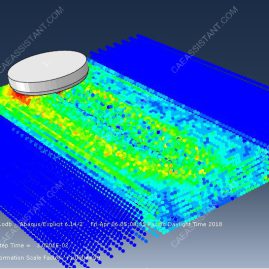
Full Course: Friction Stir Welding
Read moreFriction stir welding (FSW) is a solid-state joining process that utilizes a rotating tool to generate frictional heat, enabling the consolidation of materials without melting. FSW offers numerous benefits and is particularly valuable for welding challenging materials like aluminum alloys. It finds widespread applications in industries such as automotive, aerospace, shipbuilding, and construction, providing enhanced strength, weight reduction, and structural integrity. FSW minimizes distortion, reduces the need for post-weld machining, and eliminates issues related to solidification and cooling. Simulations using Abaqus, a popular finite element analysis software, play a crucial role in optimizing FSW processes. Engineers can investigate process parameters, evaluate weld quality, predict residual stresses and distortions, and optimize weld designs through Abaqus simulations. These simulations enable cost-effective development, improved weld quality, reduced material waste, and enhanced productivity in industrial applications. In this package, you will learn how to simulate FSW simulations in a variety of examples with different methods.
- Abaqus
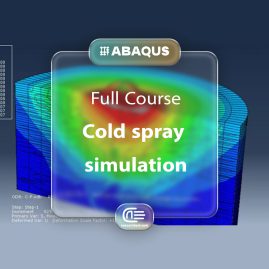
Full Course: Cold spray simulation
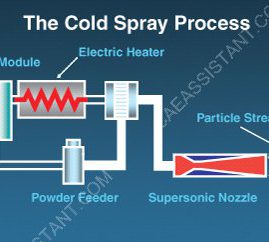
Read moreCold spray is a process used to deposit materials onto a substrate by accelerating fine powder particles to high velocities using compressed gas. Upon impact with the substrate, the particles undergo rapid plastic deformation, disrupting surface oxide films and promoting bonding between metal surfaces. Unlike thermal spray processes, cold spray avoids thermal degradation and partial oxidation of the coating material, resulting in coatings with low porosity and oxygen content. The process is highly efficient, with deposition efficiencies often exceeding 90%. Shot peening is a metal treatment process that involves bombarding a surface with small, round metallic (usually steel), ceramic, or glass beads at high velocity. This process creates small indentations on the surface, which in turn introduces compressive residual stress into the material. These two processes are different and use for separate purposes but their simulations are the same.
Cold spray is particularly important in applications where thermal degradation or oxidation of the coating material is a concern or where the coating is required to be thick and free from defects. In this package, you will learn how to simulate this process with different methods, such as ALE and SPH, with different materials. For example, Cold spray simulation of steel particles impacts on the Inconel target using ALE method.