Structural & Civil Engineering
- Abaqus
Full Course: Masonry wall simulation
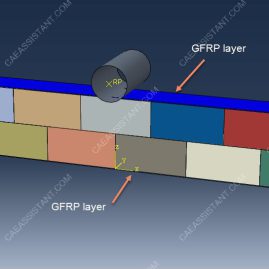
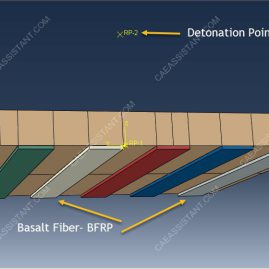
Read moreThe term masonry can refer to the construction materials brick, stone, etc. An assembly of masonry units, such as concrete blocks, burnt clay bricks, sundried bricks, stone bricks, and natural stones, linked together with mortar or grout is referred to as a masonry wall. It is important to know how these structures behave under different loading conditions, such as explosion, tension, earthquake, etc. to have the best design. In this package, you’ll learn all of that in four workshops: Behavior of a masonry wall under a couple Eulerian-Lagrangian explosion, micro modeling of a masonry wall, modeling of reinforced bricks masonry beams using GFRP reinforcement, earthquake simulation over masonry wall.
- Abaqus
Full Course: UHPC Structures simulation
Read moreUltra-High Performance Concrete structures refer to structures that are constructed using Ultra-High Performance Concrete (UHPC). UHPC is a specialized type of concrete known for its exceptional strength, durability, and resistance to various environmental and loading conditions. UHPC structures can include bridges, high-rise buildings, infrastructure components, architectural elements, and more. Simulating UHPC structures is of significant importance. Through simulation, engineers can analyze and predict the structural behavior and performance of UHPC under different loading conditions. This includes assessing factors such as stress distribution, deformation, and failure mechanisms. By simulating UHPC structures, engineers can optimize the design, evaluate the structural integrity, and ensure the safety and reliability of these complex systems. In this project package, you will learn simulating the UHPC structures with many practical examples.
- Seismic & Dynamic Analysis
Full Course: Earthquake simulation
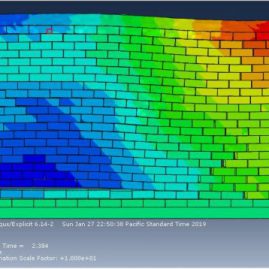
Read moreIt is known that an earthquake is a disastrous event that can cause great damage to buildings, structures, and even people. So it’s essential to know how a structure will behave when subjected to an earthquake. Therefore engineers must take into account the possibility of an earthquake when designing a structure. With finite element analyses, engineers can predict the behaviour of structures under earthquake loading. With this method, they can determine the best way to design a structure to withstand an earthquake. In this package, you can learn how to do earthquake simulation in Abaqus to have the best design for your structure to save human lives. Three practical examples are presented to you to start simulating earthquakes: “simulating an earthquake over a gravity dam in contact with water and soil”, “simulating an earthquake load over a water-filled tank”, “Abaqus-Micro model simulation of seismic load over masonry wall (concrete brick)”.