Multi-Physics Simulations
- Abaqus
Full Course: FSI analysis
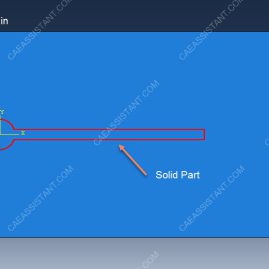
Read moreFluid-Structure Interaction (FSI) refers to the interaction between a deformable or movable structure and an internal or surrounding fluid flow. FSI simulations are vital for understanding and predicting the behavior of systems where fluid and solid components interact. These simulations enable engineers and researchers to study the effects of fluid forces on structures and vice versa. FSI simulations are crucial in various fields, including aerospace, civil engineering, biomechanics, and automotive industries. They provide valuable insights into the performance, safety, and reliability of engineering systems. By accurately modeling the complex interactions between fluids and structures, FSI simulations can identify potential issues such as vibrations, instabilities, and structural failures. In this package, you’ll learn simulating FSI in Abaqus within 3 workshops.
- Abaqus
Full Course: Piezoelectric simulation
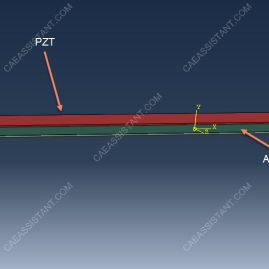
Read morePiezoelectric materials are unique materials that generate an electric charge in response to applied mechanical stress, such as pressure or vibration. They are used in a wide range of applications, including sensors, actuators, and energy harvesting devices. The piezoelectric analysis is the process of studying the mechanical and electrical behavior of piezoelectric materials under various loading conditions. It involves modeling and simulating the response of piezoelectric materials to external stimuli, such as electrical potential or mechanical stress. The importance of piezoelectric analysis lies in its ability to evaluate the performance and optimize the design of piezoelectric devices, which are becoming increasingly important in various industries, including medical, automotive, aerospace, and energy. Piezoelectric analysis can help improve the efficiency, accuracy, and durability of piezoelectric devices, leading to advancements in technology and innovation. In this package you will learn how to model piezoelectric materials in Abaqus.
- Abaqus
Full Course: Water Simulation
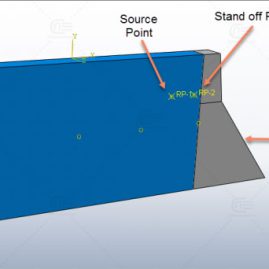
Read moreWater is the primary component of the Earth’s hydrosphere and the fluids of all known living things. Therefore, we build dams to store the water and transfer it through piping systems to use it for daily activities and produce energy. In industries, we use it as a cooler, solvent, hydroforming, cutting, etc. In this package, there are nine practical examples, such as the ones mentioned to teach you how to simulate water in Abaqus. These examples are explosions in the depth of the water, gravity dam simulation subjected to the underwater explosion, ball impact to the water, water jet cutting, etc.
- Abaqus
Full Course: Explosion simulation
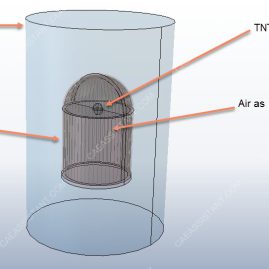
Read moreThis training package teaches simulation of the explosion in ABAQUS with a variety of examples. In this training package, different methods for implementation are discussed.
- Abaqus
Full Course: CFD Analysis
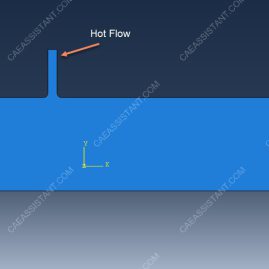
Read moreFluid-Structure Interaction also known as FSI is a multiphysics problem where the fluid and structure are coupled. The fluid flow can cause the structure to deform, and the deformation of the structure can affect the flow. So when you want to design something, you need to know how the structure will deform and how that deformation affects the flow. Common examples of FSI analysis are airplanes, cars, spacecrafts, and buildings. Other examples like junctions in piping systems, or the human circulatory system. CFD is a branch of research that uses numerical methods to solve the mathematical equations governing fluid flow, heat transfer, mass transfer, chemical reactions, and related phenomena. In Abaqus, you can model both methods. In this package, we present to you three workshops to get you started with Abaqus CFD and FSI: “Using Abaqus CFD methods, examining heat mixing and reverse flow characteristics in a T-junction”, “impact of air velocity over the short column”, “simulate fluid structure interaction on an aluminum body with a flexible tail in Abaqus”.
- Coupled Fields & Dynamics
Full Course: Acoustic simulation
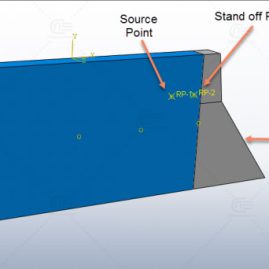
Read moreThe study of mechanical waves in gases, liquids, and solids, including issues like vibration, sound, ultrasound, and infrasound, is the focus of the physics subfield of acoustics. A shock wave is a sort of disturbance that propagates across a medium faster than the local speed of sound. In industry, we use acoustic loading in cases such as hydraulic forming, SONAR, seismology, acoustic emission, vibration analysis, engine testing, etc. In this package, you will learn how to model acoustic loadings and shock loadings in four workshops: Deformation behavior of a stiffened panel subjected to underwater shock loading, Acoustic method-based numerical simulation of the electro-hydraulic forming process, Failure modes of concrete gravity dams simulation exposed to an underwater explosion, and Simulation of hull Coupled acoustic-structural response subjected to an underwater explosion.