Structural & Civil Engineering
- Abaqus
Full Course: Geostatic analysis
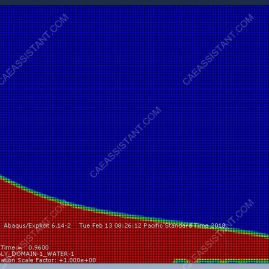
Read moreGeostatic Relates to the pressure exerted by the earth or similar substance. Total stress at a point due to the combined weight of the soil or rock (solids plus water) and the load on the foundation is called Geostatic stress. Geostatic analysis is used in cases such as earthquakes, designing a dam, analyzing the foundation of a structure, etc. In this package, three workshops are presented to learn the Geostatic analysis: The first workshop analyzes a water column broke under the weight of gravity, the second workshop simulates an earthquake load over a gravity dam in contact with water and dirt, the last workshop models cylindrical tank’s water sloshing phenomenon.
- Abaqus
Full Course: Dam simulation
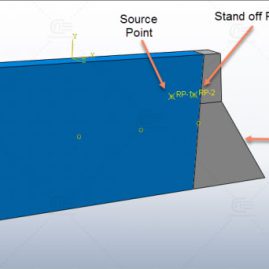
Read moreA dam is a large concrete or earthen barrier built across a river or other waterway to create a reservoir for storing water. Dams are critical infrastructure for providing water for irrigation, drinking, and hydroelectric power generation. However, they are also susceptible to damage from natural disasters and human-made threats, such as earthquakes, landslides, and terrorist attacks. Abaqus can predict the behavior of dams under different loading conditions, including earthquakes, floods, and explosions. It also can model the interaction between the dam, water, and soil, making it a comprehensive and powerful tool for dam engineering. In this package, you will learn how to model dams in different conditions, such as dam simulation subjected to earthquakes in interaction with water and soil and dam simulation subjected to an underwater explosion.
- Abaqus
Full Course: Mohr-coulomb usage
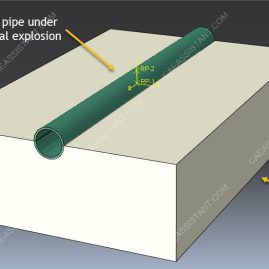
Read moreA mathematical model called the Mohr-Coulomb theory describes how brittle materials, such as concrete or rubble piles, react to both shear stress and normal stress. This rule is followed by the majority of traditional engineered materials in at least some of their shear failure envelope. In this package, you will learn how to use this theory in four practical examples: Analysis of surface explosion damage to an underground box tube in ABAQUS, dynamic analysis of a tunnel in soil subjected to internal blast loading, An internal explosion-related numerical simulation of the behavior of a pipeline’s damage mechanics, and for cases utilizing crashworthiness, simulate an Eulerian method to soil impact analysis.
- Abaqus
Full Course: Tunnel Simulation
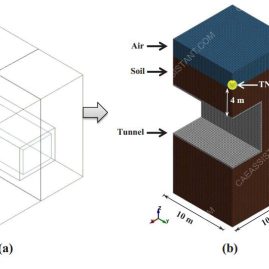
Read moreA tunnel is an underground or underwater passage for transportation, utility lines, or water pipelines. Tunnels are critical infrastructure, and their safety and reliability are essential for ensuring public safety and the smooth functioning of society. Tunnel simulation involves using computer models to predict the behaviour of tunnels under different types of loading conditions, such as earthquakes, floods, or explosions. These simulations can help engineers and policymakers assess the safety and reliability of tunnels, identify potential failure modes, and develop strategies to mitigate risks. By using advanced simulation techniques, engineers can better understand the complex behavior of tunnels and design more effective and durable structures. Tunnel simulation is an essential tool for ensuring the safety and resilience of tunnels and the infrastructure they support. Some workshops are presented in this package to teach you how to simulate and analyze tunnels in Abaqus; two of these workshops are Damage analysis of an underground box tunnel subjected to surface explosion and Tunnel dynamic analysis subjected to internal blast loading using CEL method.