


Dam simulation in Abaqus
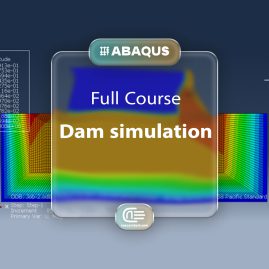
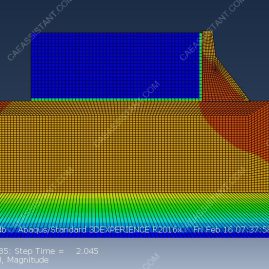
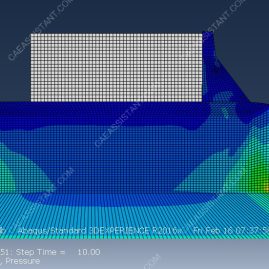
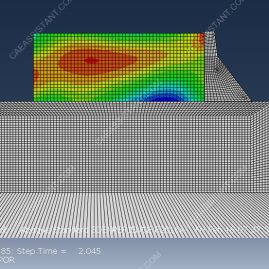
Dam simulation involves using computer models to predict the behavior of dams under different types of loading conditions, such as earthquakes, floods, and explosions. Abaqus is a powerful software tool that can be used for dam simulation, utilizing finite element analysis to accurately predict the behavior of dam structures. For example, if you want to simulate earthquake load on a dam in interaction with water and soil, you can use CDP material for the dam, Mohr-Coulomb for the soil, and Acoustic property (Bulk Modulus) for the water; then, use the implicit solver to analyze the model. Also, failure modes analysis can be done when a dam is subjected to different loading conditions, such as underwater explosion; in this case, the Explicit solver can be used along with the UNDEX procedure. You can read more detail in the description of the workshops below.
Workshop 1: gravity dam earthquake simulation in interaction with water and soil
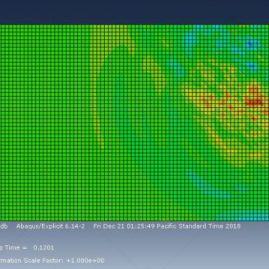
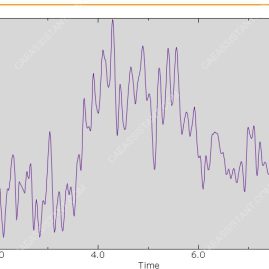
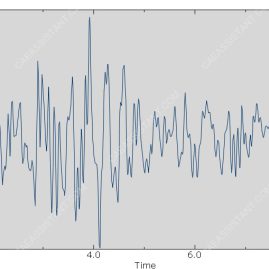
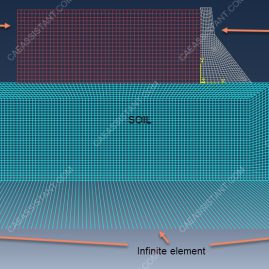
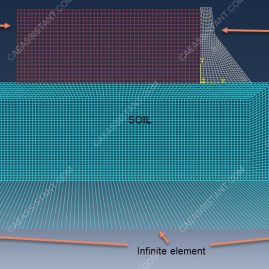
The video demonstrates a simulation of the effects of earthquake load on a gravity dam, taking into account its interaction with the surrounding water and soil. The model represents all components in two dimensions, using CDP material for the dam, Mohr-Coulomb for the soil, and Acoustic property (Bulk Modulus) for the water. An infinite element was created for the soil that is far from the foundation. The simulation was carried out using a Dynamic implicit step, which is suitable for this type of analysis, with a duration of 10 seconds. The earthquake-induced acceleration was applied to the depth of the soil. (Abaqus dam simulation)
Workshop 2: Failure modes analysis of dams subjected to underwater explosion
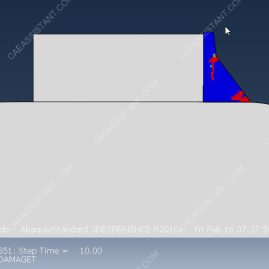
The rising global tensions have led to an increased risk of terrorist bombings or accidental explosions, which pose a significant threat to important economic, military, and civilian facilities. Consequently, research on the safety of structures against such events has become a growing concern. As the demand for power, irrigation, and drinking water increases, the construction of high dams is becoming more common. However, these dams may be targeted by terrorists due to their political and economic significance, and their failure could result in economic disaster and widespread casualties, attracting significant media attention. Since the September 11 attacks, the risk of bomb attacks on dam structures has become a major public concern, and protecting these structures against blast loads is now a key aspect of homeland security. To assess their safety against such threats, it is crucial to study the failure modes and antiknock performance of concrete gravity dams subjected to underwater explosions. However, the physical processes involved in an explosion in water and the subsequent shock wave propagation are highly complex, and the response of a dam subjected to explosion shock loading is much more intricate than under other loadings, such as static or earthquake loads.
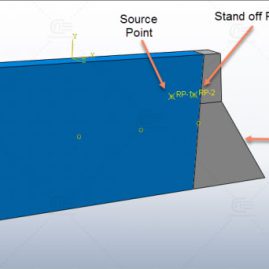
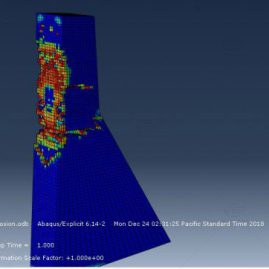
To simulate the behavior of a dam and water, a three-dimensional model was employed. In order to accurately describe the response of concrete to high strain rates and large stresses, an appropriate material model was required to account for damage. The simulation utilized a Dynamic explicit step, along with the UNDEX procedure.
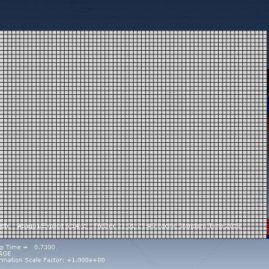
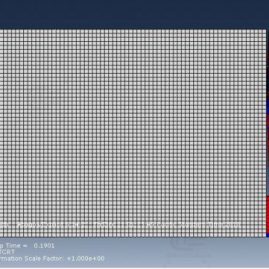
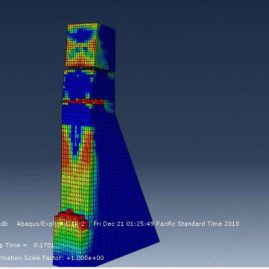
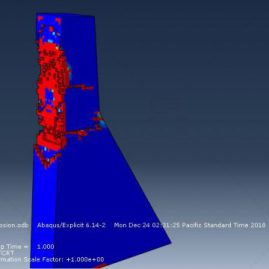
During the process of the Abaqus dam simulation, the distribution of damage is readily apparent and can be altered by adjusting the amount of TNT used or by changing the position of the detonation source, which is the TNT in this case.
It would be useful to see Abaqus Documentation to understand how it would be hard to start an Abaqus simulation without any Abaqus tutorial.

Reviews
There are no reviews yet.