



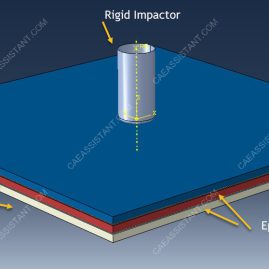
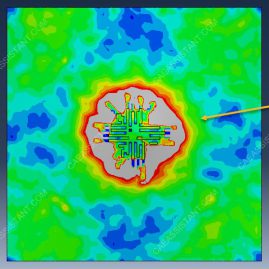
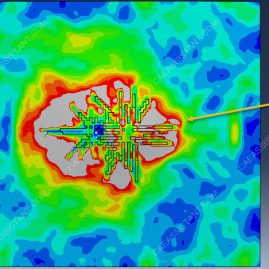
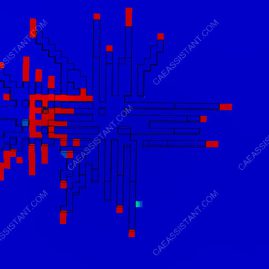
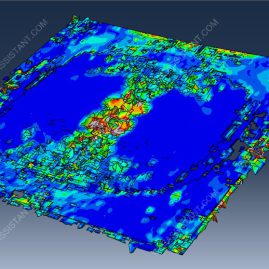
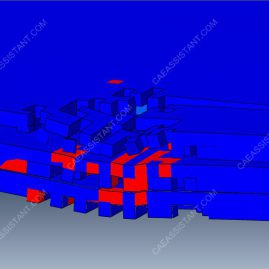
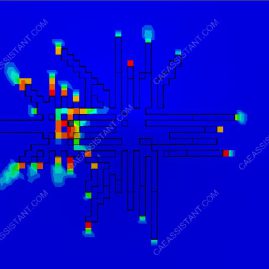
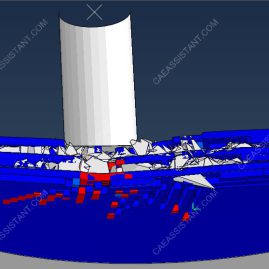
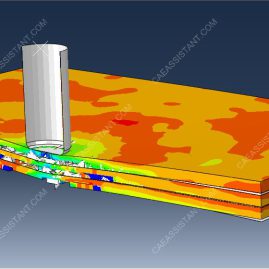
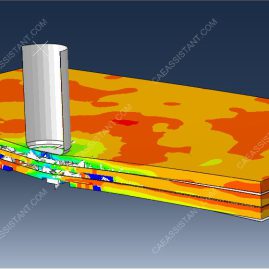
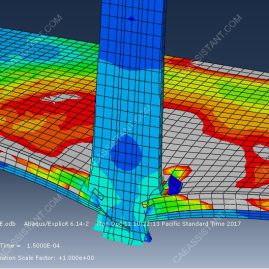
In this tutorial, the low-velocity impact on a composite panel (three glass layers and two epoxy layers) is simulated in Abaqus.
The three glass layers are modeled as three-dimensional solid parts.
The two epoxy (glue) layers are also modeled as three-dimensional solid parts.
The rigid projectile and supporting plate are modeled as shell parts.
To represent epoxy behavior, a cohesive material model is used. The traction–elasticity type with a traction–separation damage law is applied. For the glass layers under impact loading, Abaqus provides several suitable material models. Some of these can be implemented through user subroutines or input file options.
The simulation uses a dynamic explicit step with mass scaling to reduce computation time and improve stability. Perfect contact is assumed between the glass and epoxy interfaces. The general contact algorithm is applied to capture all interactions in the contact domain. Boundary conditions are set by fixing the bottom rigid plate, while an initial velocity is assigned to the projectile. A fine mesh is required to achieve accurate results.
After the first simulation, outputs such as stress, strain, damage, and failure are available. In the second simulation, the results from the first analysis are used as the initial condition. This means the model starts in a damaged state, and further outputs can be observed, including stress and failure patterns.
Reviews
There are no reviews yet.