


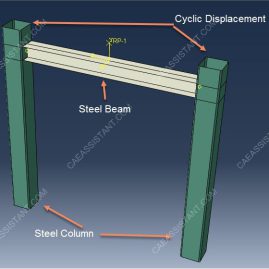
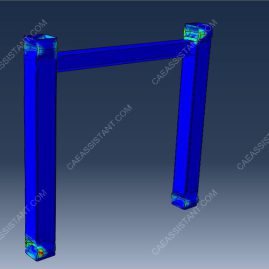
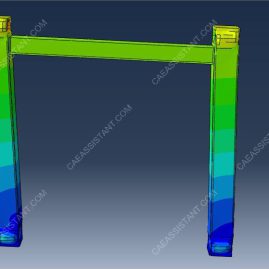
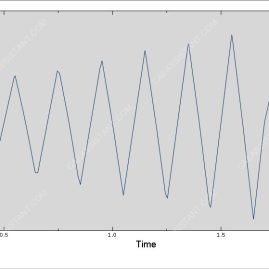
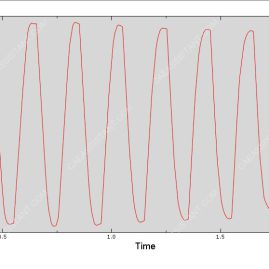
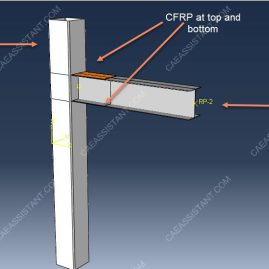
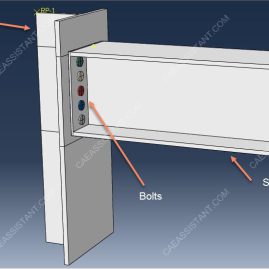
In this tutorial, the cyclic loading of a steel beam–column structure and its damage investigation in Abaqus are studied. The beam is modeled as a three-dimensional shell part, and the two steel columns are also modeled as three-dimensional shell parts.
To simulate the steel beam and columns under cyclic loading, an elastic–isotropic plasticity model is used, coupled with a ductile damage criterion to predict damage during the analysis. While kinematic or combined plasticity can be applied, isotropic plasticity with ductile damage provides more accurate results for damage prediction.
A general static step is chosen for the analysis. To avoid early convergence issues, adjustments are made to the convergence settings. Perfect (ideal) contact is defined between the beam and columns. The general contact algorithm is applied to account for regions with possible interference during the simulation.
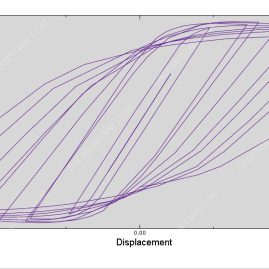
Boundary conditions are set as follows: the bottom nodes of the columns are fixed, and a displacement boundary condition with a cyclic loading protocol (defined by amplitude) is applied to the columns. A fine mesh is recommended to achieve reliable results.
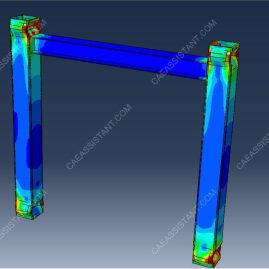
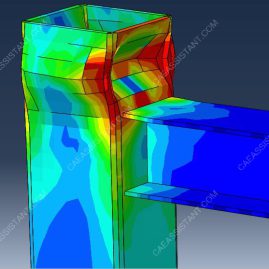
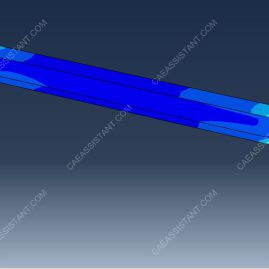
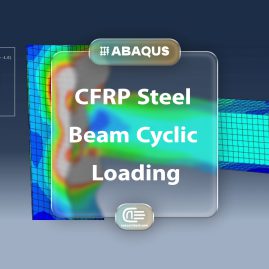
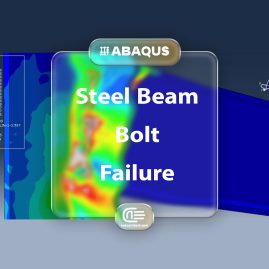
After running the simulation, results such as stress, strain, damage, failure, and force–displacement diagrams can be obtained. Figures of the results are shown below.

Reviews
There are no reviews yet.