



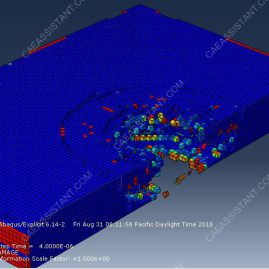
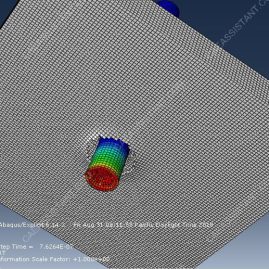
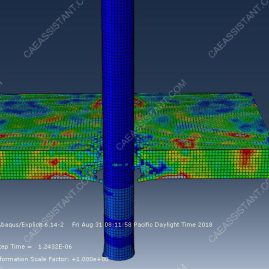
In this tutorial, the high-velocity impact of a ceramic target is studied using the Johnson–Holmquist material model. Ceramic materials are widely used in armor protection applications. Johnson, Holmquist, and their colleagues have developed constitutive relations to describe the behavior of ceramics under large strain, high strain rate, and high-pressure impact conditions.
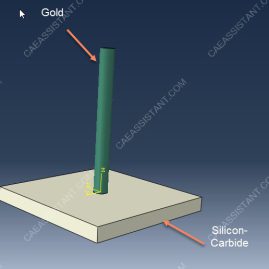
In this example, both the JHB and JH-2 material models are applied to investigate the penetration velocity of a gold projectile impacting a silicon carbide target. The computed results are compared with published data from Holmquist and Johnson.
The target material is silicon carbide, which is extremely hard and mainly used under compressive loading. It can sustain only limited tension. Typical applications include bulletproof vests and car brakes due to its high endurance. The strength of silicon carbide depends on pressure, and in high-speed impact scenarios, material damage strongly influences strength evolution. Once fully failed, silicon carbide cannot sustain any load.
The projectile material is gold, which is relatively soft compared to the ceramic target.
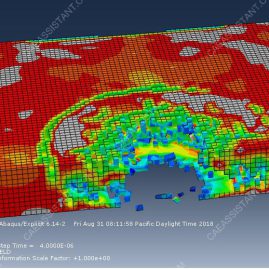
The simulation uses a Lagrangian description for both projectile and target. General contact with surface erosion is applied in all cases. Element deletion and node erosion are considered. The JH-2 model, unlike the JHB model, assumes that the damage variable increases progressively with plastic deformation.
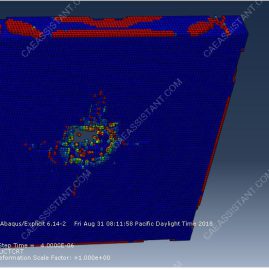
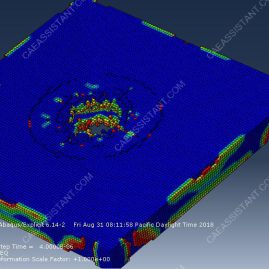
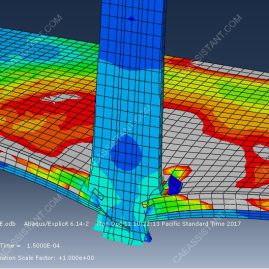
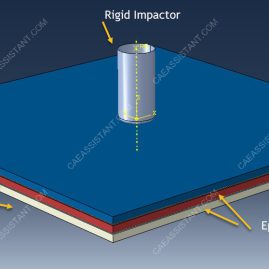
Figures of the part positions and simulation results are provided for visualization.

Reviews
There are no reviews yet.