

The study of interaction between two impacting bodies, known as impact dynamics or terminal ballistics, has many important applications. Examples include bullet impact on armor, occupant and pedestrian safety in automobile accidents, or tool drops on aircraft wings. Understanding how materials deform under impact loading is critical not only for designing better products but also for saving lives. Knowledge of material response under such conditions helps engineers estimate, improve, and extend the performance and lifespan of structures.
Impact dynamics mainly depend on two variables: the geometry and the material of the impacting bodies. Geometry is often dictated by design requirements rather than impact performance. For instance, an aircraft wing must have an aerofoil shape, armor must fit the human body with limited thickness for mobility, and a bullet must be conical for penetration. Ultimately, the material response determines structural performance under impact loading.
Different materials behave differently under impact. Ceramics are widely used in armor as a front layer due to their high penetration resistance. Epoxy and epoxy-based composites are common in the automobile industry because of their high strain-to-failure and energy absorption capacity. While material choices have matured, further improvements are possible through intelligent design, such as reducing weight or increasing energy absorption.
In this simulation, silicon carbide, steel, aluminum, and three CFRP (Carbon Fiber Reinforced Polymer) layouts are used as sandwich panels subjected to rigid impact. Finite Element (FE) simulations are performed in Abaqus/Explicit to study the deformation behavior of these materials under impact loading.
Terminal ballistics between two solid bodies generate extremely high pressures and temperatures at the impact interface for a very short duration. These conditions create shock waves that later decay into elastic waves at larger distances. During this brief period, materials may undergo physical changes such as melting or evaporation, and mechanical changes such as strength loss, local fracture, or complete shattering. Although irreversible, thermodynamic equilibrium is maintained.
Material properties in terminal ballistics are described either by an equation of state (accounting for compression at high pressure and temperature) or by constitutive relations. In this study:
Aluminum and steel are modeled using Johnson-Cook plasticity and damage.
CFRP is modeled using Hashin’s damage criterion.
Silicon carbide is modeled using the Johnson-Holmquist (JH2) model.
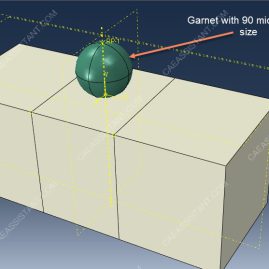
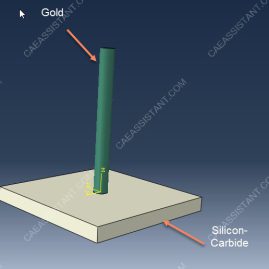
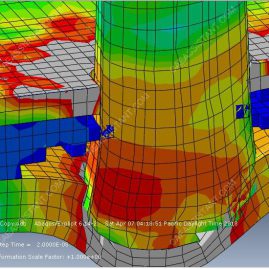
A dynamic explicit step and surface-to-surface contact are defined in the analysis. The projectile penetrates the sandwich panel, causing significant deformation. Figures of the assembled parts and simulation results are provided below.




Reviews
There are no reviews yet.