


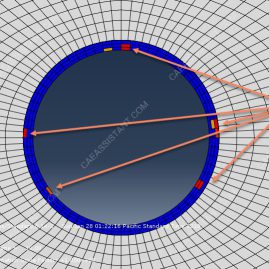
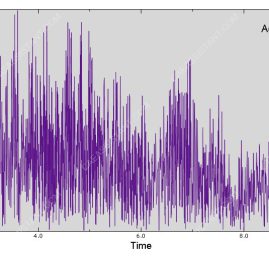
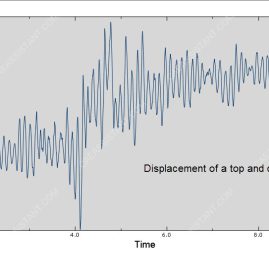
In this tutorial, we simulate earthquake loading on a concrete tunnel interacting with surrounding soil using Abaqus. Tunnels, especially those built in rock, are often considered naturally resistant to earthquake effects such as shaking, fault movement, and ground deformation. However, recent case studies show that even tunnels in rock can experience significant demands during earthquakes with peak ground accelerations (PGA) below 0.5 g. Therefore, including dynamic forces and earthquake-induced displacements in tunnel design is important for achieving reliable performance.
The soil and the concrete tunnel are modeled as two-dimensional parts. The Concrete Damaged Plasticity (CDP) model is used for the concrete, and the Mohr–Coulomb plasticity model is applied to the soil.
The analysis is performed in three main steps. In the first step, the soil weight is applied. In the second step, gravity is assigned to all parts. In the third step, earthquake acceleration is applied to the assembly. Geostress is also introduced to the soil using a predefined field.
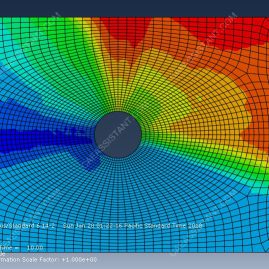
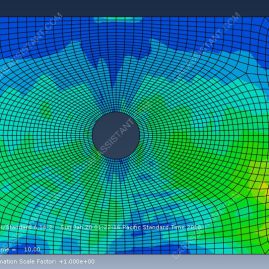
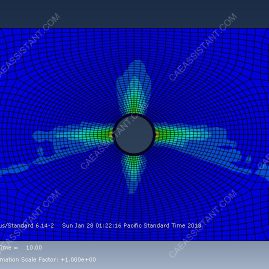
During the simulation, tensile damage develops in the concrete tunnel, and plastic strain forms in the soil. These results, along with other outputs, can be extracted for further interpretation. Figures from the simulation are shown below.

Reviews
There are no reviews yet.