


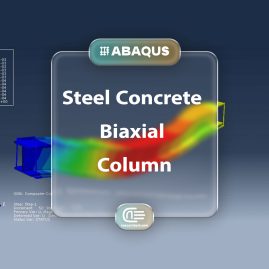
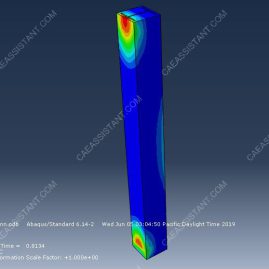
In this tutorial, the simulation of a steel–concrete composite column under vertical and horizontal loads in Abaqus is presented.
Steel–concrete composite columns are modern structural members widely used because of their high load-bearing capacity, efficient use of materials, high stiffness, ductility, and large energy absorption capacity. Combining reinforced concrete (RC) with structural steel sections offers several advantages compared to traditional RC or steel members. Concrete provides fire resistance to the steel section and helps prevent buckling. Using composite columns also improves the strain distribution in concrete compared to conventional RC columns.
However, steel–reinforced concrete (SRC) columns require both longitudinal and transverse reinforcement to prevent spalling of the concrete when subjected to axial load, fire, or seismic action.
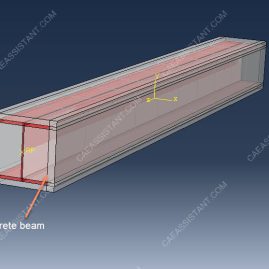
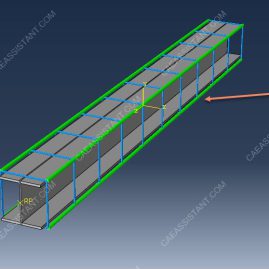
In the model, the concrete column and steel beam core are created as three-dimensional parts. The reinforcing bar is modeled as a wire, and the pusher plate is modeled as a rigid body. Steel members are defined with an elastic–plastic material model including ductile damage, while the concrete column uses the Concrete Damage Plasticity (CDP) model.
Both static general and dynamic explicit procedures are applied separately, and the results are compared. The contact between the concrete and steel beam is assumed to be perfect, and the reinforcing bars are embedded in the concrete host. A vertical concentrated force is applied to the top surface of the column, while a pressure load is applied to the side surface of the concrete.
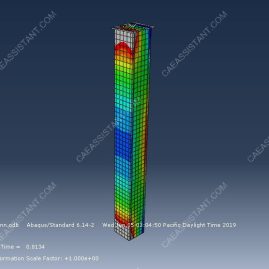
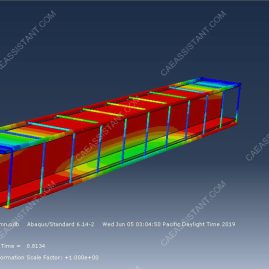
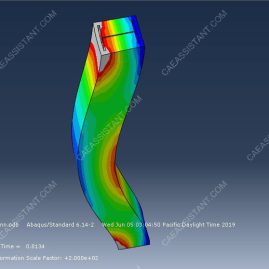
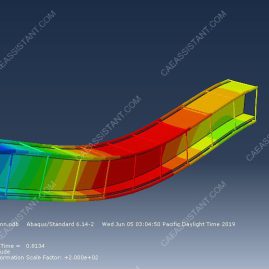
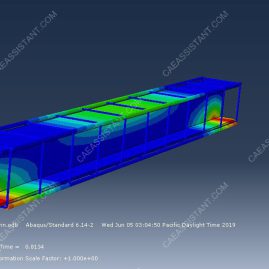
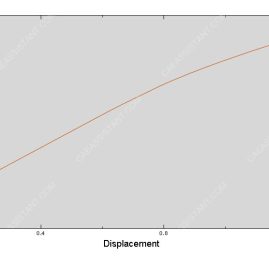
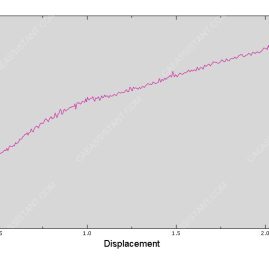
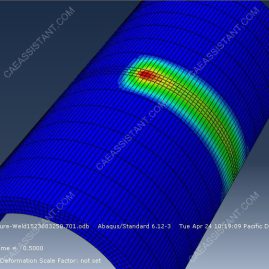
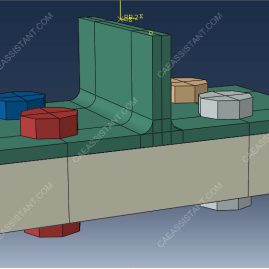
After running both static and dynamic simulations, results such as stress, strain, damage, displacement, and force diagrams are obtained. Figures of the assembled parts and simulation results are provided for reference.
Reviews
There are no reviews yet.