


In this tutorial, cyclic loading of a steel box column with stiffeners is simulated in Abaqus to investigate damage behavior.
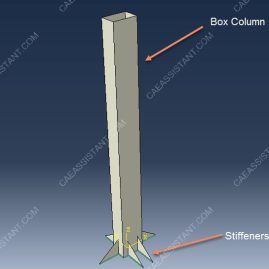
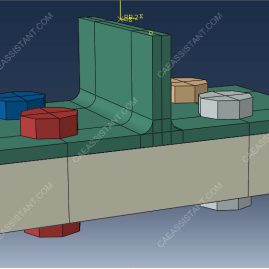
The column is modeled as a three-dimensional shell part, while the stiffeners are modeled as planar shell parts. The stiffeners are placed at the end of the column to act as a weld zone. Their purpose is to strengthen the column and shift the damage zone away from the end.
Normally, kinematic or combined plasticity models are used to simulate cyclic behavior because they allow a variable yield surface. However, in this study the main goal is to identify the damage and failure location. Therefore, isotropic plasticity with a ductile damage criterion is applied. This criterion can predict the damage zone under cyclic loading.
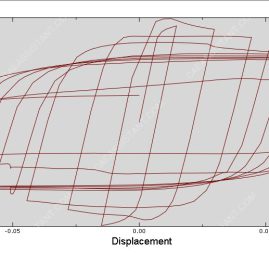
A general static step is used. The end of the column and the bottom edges of the stiffeners are assumed to be welded, so fixed boundary conditions are applied there. Cyclic loading is defined using a specific protocol to control the load amplitude.
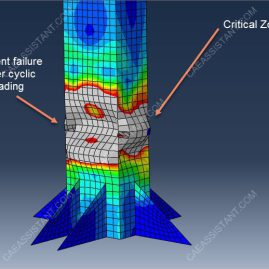
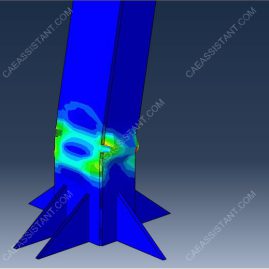
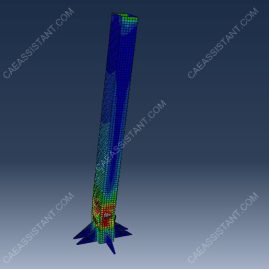
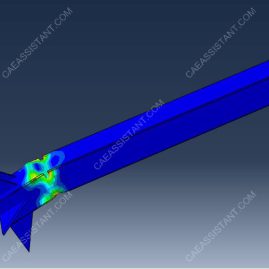
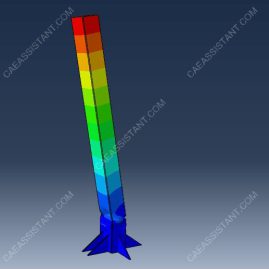
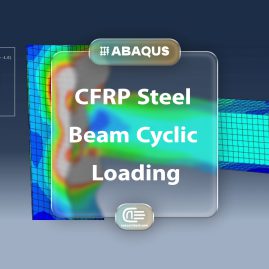
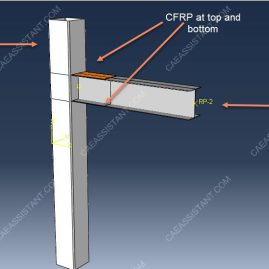
Mesh quality plays an important role in result accuracy. The simulation results show that the damaged zone shifts from the end of the column to a higher location due to the effect of the stiffeners. Output data such as stress, strain, and damage distribution are available. Figures of the assembled part and results are provided below.

Reviews
There are no reviews yet.