


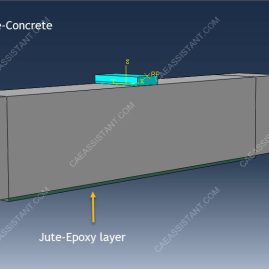
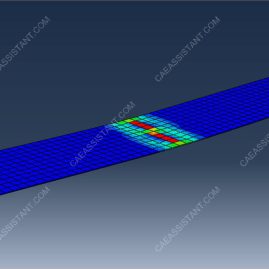
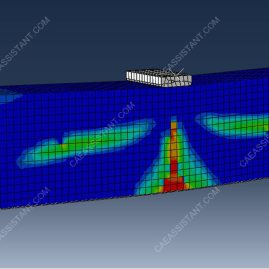
In this tutorial, the three‑point bending test of a UHPC beam reinforced with a Jute–Epoxy lamina is simulated in Abaqus. The UHPC beam is modeled as a three‑dimensional solid part. The Jute–Epoxy lamina is modeled as a three‑dimensional shell part with four layers. A rigid body shell part is used to apply the displacement load.
Ultra‑High Performance Concrete (UHPC) is increasingly used for strengthening and rehabilitating reinforced concrete beams. Its high tensile and compressive strength, ductility, and durability make it suitable for demanding structural applications, especially in bridge engineering. The Concrete Damaged Plasticity (CDP) model in Abaqus is used to represent the nonlinear tensile and compressive behavior of UHPC. This model can capture both tensile and compressive damage during the analysis.
Jute‑based green composites are gaining attention due to their good strength‑to‑weight ratio, high damping, low cost, and corrosion resistance. They are widely used in automotive applications and are considered an environmentally friendly alternative to synthetic fibers. In this simulation, the Jute–Epoxy lamina is modeled using a conventional shell with four layers.
A general static step is selected, with adjustments to the convergence settings to prevent early non‑convergence. Surface‑to‑surface contact with friction is defined between the rigid body and the concrete beam. Ideal contact is used between the UHPC beam and the Jute–Epoxy lamina. The beam ends are fixed, and displacement is applied to the rigid body. A fine mesh is required to obtain accurate results.
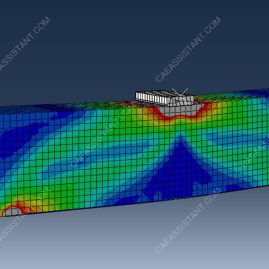
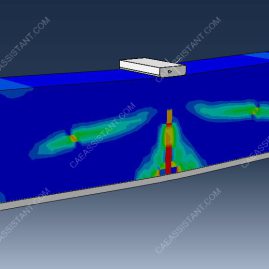
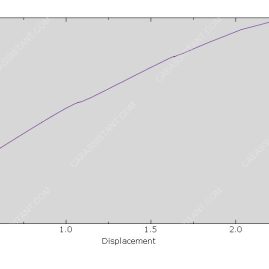
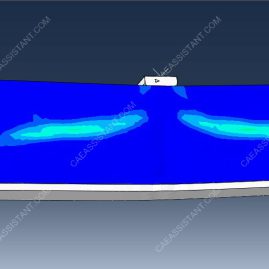
After running the simulation, results such as stress, strain, tensile and compressive damage, and the force–displacement curve are available. Several example result figures are shown below.
Reviews
There are no reviews yet.