


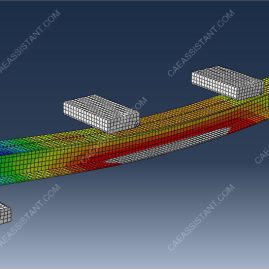
In this tutorial, a four‑point bending simulation of an Ultra‑High‑Performance Concrete (UHPC) beam with a steel beam core is carried out in Abaqus. UHPC has a compressive strength greater than 21.7 ksi (150 MPa) and a flexural strength greater than 0.72 ksi (10 MPa) at 28 days. The concept of UHPC was first developed by Richard and Cheyrezy in the early 1990s at the Bouygues Laboratory in France.
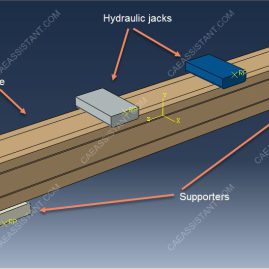
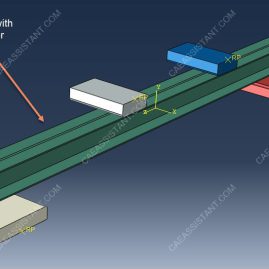
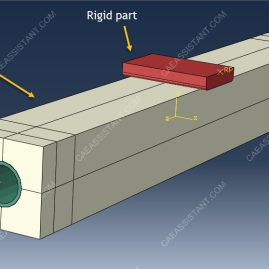
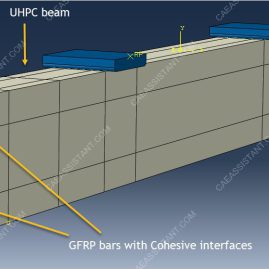
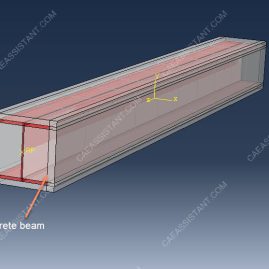
Both plain and fiber‑reinforced UHPC mixtures can be produced using commercially available materials. In this model, the UHPC beam is created as a three‑dimensional solid part. The steel beam core is also modeled as a three‑dimensional solid part. The boundary zones and hydraulic jacks are represented using rigid shell parts.
The Concrete Damaged Plasticity (CDP) model is used to simulate the UHPC behavior. CDP is a continuum, plasticity‑based damage model that captures tensile cracking and compressive crushing as the main failure mechanisms. Material properties for UHPC are taken from the reference paper.
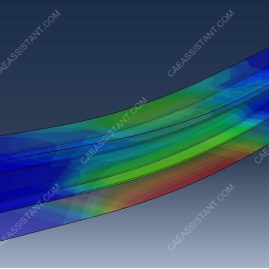
The steel core uses an elastic‑plastic material model with a ductile damage criterion to predict damage during bending. The analysis is performed using a general static step with adjusted convergence settings. Surface‑to‑surface contact with friction is defined between the rigid bodies and the concrete beam. The contact between the steel core and the concrete is assumed to be perfect (ideal bonding).
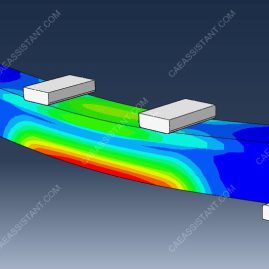
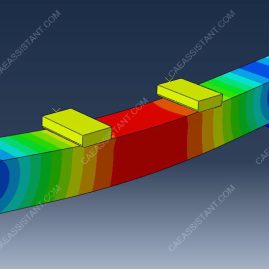
Two bottom rigid bodies are fixed, and displacement is applied to the two top rigid bodies using an amplitude curve. A fine mesh is required to obtain accurate results.
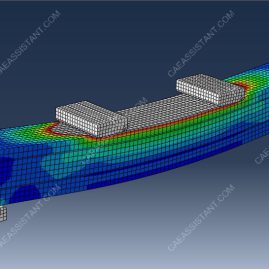
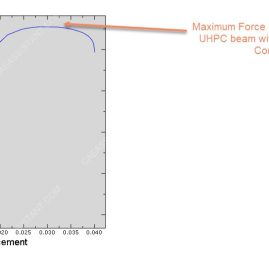
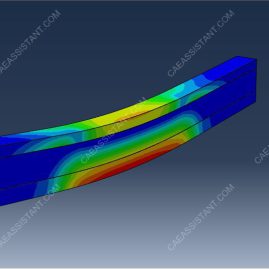
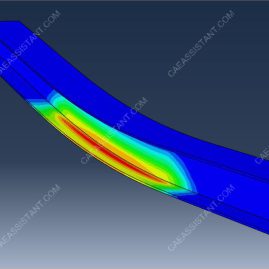
After the simulation, various results can be extracted, including stress, strain, damage variables, and the force‑displacement response. Example result figures are shown below.
Reviews
There are no reviews yet.