


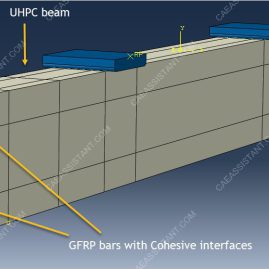
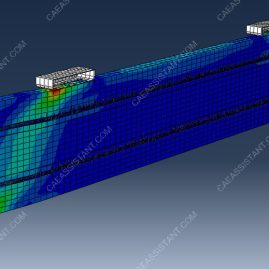
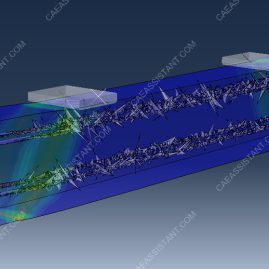
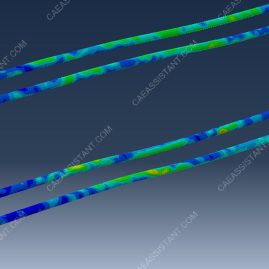
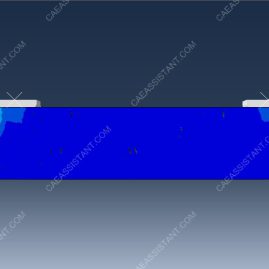
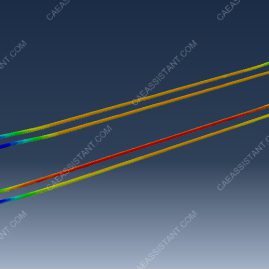
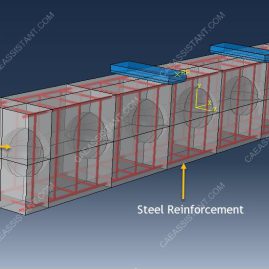
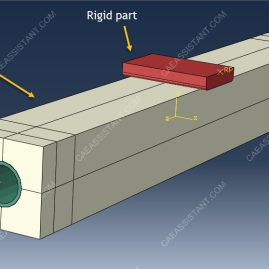
In this tutorial, the dynamic bending simulation of a UHPC beam reinforced with GFRP bars in Abaqus is presented. The Ultra-High-Performance Concrete (UHPC) beam is modeled as a three-dimensional solid part. A cohesive layer is introduced as the interface between the UHPC and the GFRP bars, also modeled as a solid part. The GFRP bars themselves are modeled as three-dimensional solids, while two rigid bodies are used to apply the load.
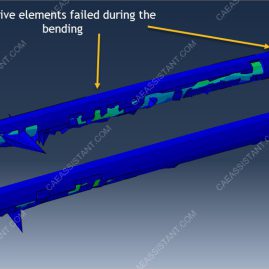
To represent the UHPC material, the Concrete Damaged Plasticity model is applied. This model uses both compression and tension data to capture the behavior of UHPC under dynamic bending loads. For the cohesive layer, elastic traction data and a traction–separation law are defined to simulate possible failure. The GFRP bars are modeled using elastic engineering constants.
A dynamic explicit step is chosen for the analysis, as it is suitable for large deformations and separation effects that occur during bending between UHPC and GFRP bars. The general contact algorithm with friction is used to account for all contact interactions. Perfect (ideal) contact is applied between the surfaces of the concrete and cohesive layer, as well as between the GFRP and cohesive layer.
Boundary conditions are defined by fixing the two bottom surfaces of the beam. Displacement with amplitude is applied to the two top rigid bodies. A fine mesh is used to ensure accurate results.
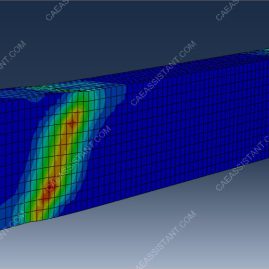
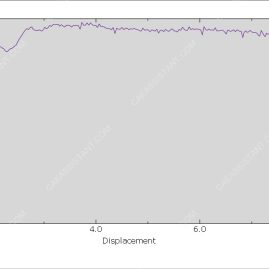
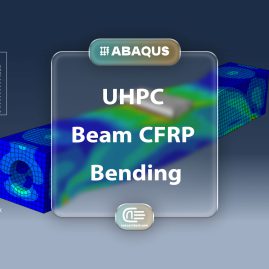
After the simulation, results such as stress, strain, plastic strain, displacement, and the force–displacement diagram are available. Figures of the assembled parts and simulation results are shown below.

Reviews
There are no reviews yet.