


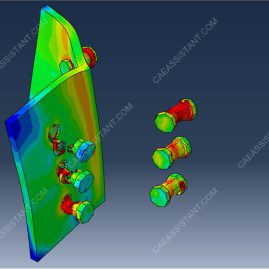
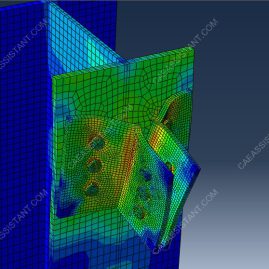
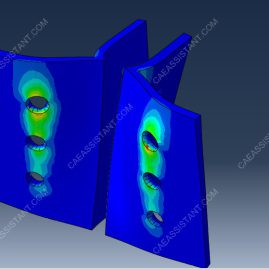
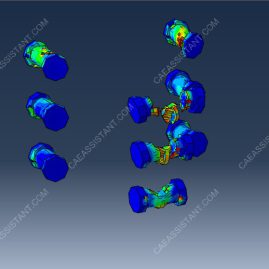
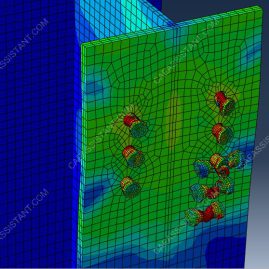
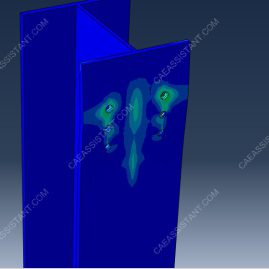
In this tutorial, the simulation of steel bolted double-angle connections under dynamic load using Abaqus failure analysis is presented.
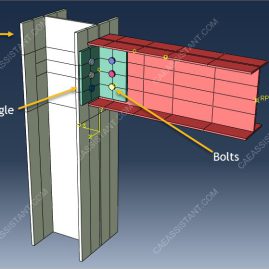
- The beam and column are modeled as three-dimensional solid parts.
- The bolts are also modeled as three-dimensional solid parts.
- Connections play a crucial role in maintaining the stability of steel structures by ensuring continuity of load paths between elements.
Steel grade 14 with an elastic–plastic material model is applied to all parts. To predict damage and failure in the bolts and beam, the ductile damage criterion is used. This allows damage to be observed after the simulation.
A dynamic explicit step is chosen, as it is suitable for this type of analysis. The mass scaling technique is applied to reduce simulation time and improve model stability. Surface-to-surface contact is defined for all interactions, with rough contact properties assigned to the bolt connections.
Boundary conditions are set as follows:
- The two ends of the column are fixed.
- A displacement is applied to the end of the beam.
Partitions are created in all parts to achieve good mesh quality. The mesh is refined, especially in the contact zones, to ensure accurate results.
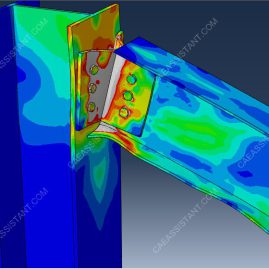
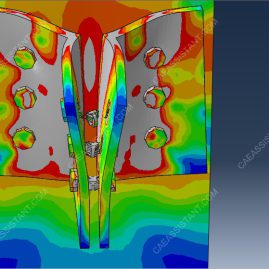
After the simulation, results such as stress, strain, damage, and failure are available. Figures of the results can be viewed for better understanding.
Reviews
There are no reviews yet.