


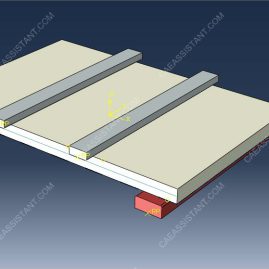
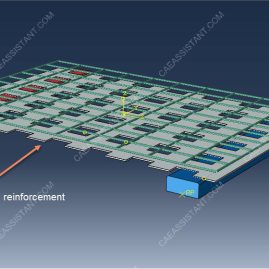
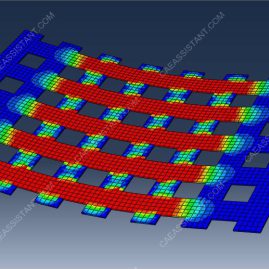
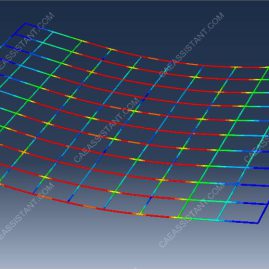
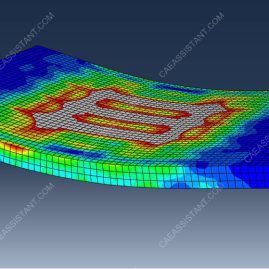
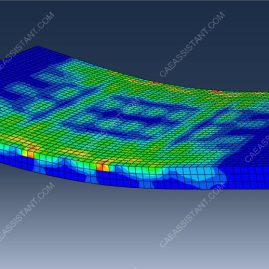
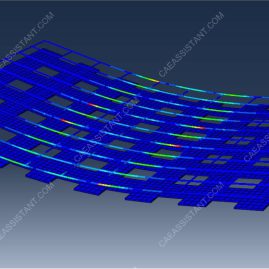
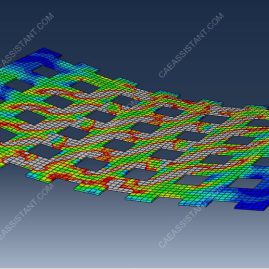
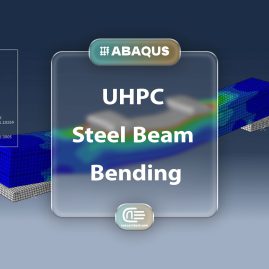
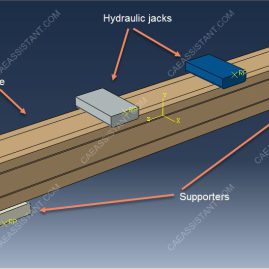
In this tutorial, the four‑point bending simulation of a UHPC slab reinforced with steel bars and a GFRP sheet is carried out in Abaqus. The UHPC slab is modeled as a three‑dimensional solid part. The steel bars are modeled as three‑dimensional wire parts. The GFRP sheet, consisting of eight layers, is modeled as a three‑dimensional shell part. The supports and loading plates are modeled as rigid shell bodies.
Ultra‑High‑Performance Concrete (UHPC) is defined using the Concrete Damaged Plasticity (CDP) model to capture its nonlinear behavior under bending. The steel bars are assigned an elastic–plastic material model. The GFRP sheet is modeled as an elastic material using engineering constants, and Hashin’s damage criterion is applied to study damage initiation and propagation during the bending test.
A general static step is used, with adjustments to the convergence settings to prevent early non‑convergence. Surface‑to‑surface contact is defined between the rigid bodies, the UHPC slab, and the GFRP sheet. The steel bars are embedded in the concrete using the embedded region technique. Perfect bonding is assumed between the UHPC slab and the GFRP sheet.
Fixed boundary conditions are applied to the two bottom rigid bodies. A displacement boundary condition with a smooth amplitude curve is applied to the two top rigid bodies to ensure gradual loading. A fine mesh is recommended for all parts to achieve accurate results.
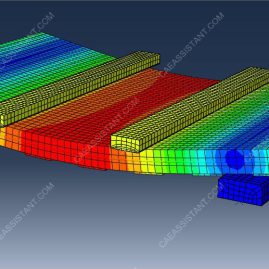
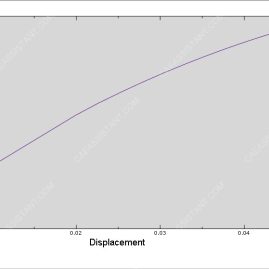
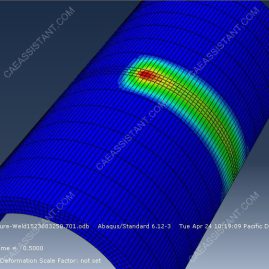
After running the simulation, results such as stress, strain, damage distribution, and the force–displacement curve can be extracted. Example result figures are shown below.

Reviews
There are no reviews yet.