


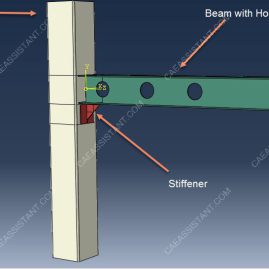
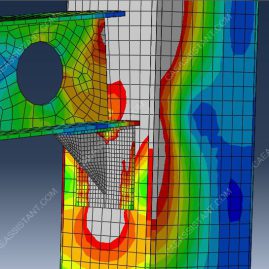
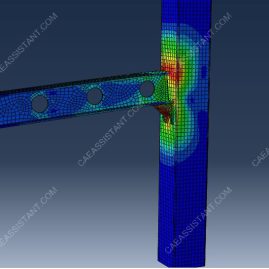
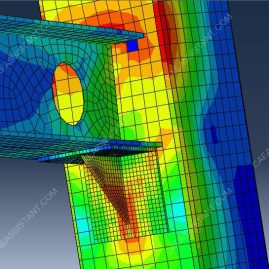
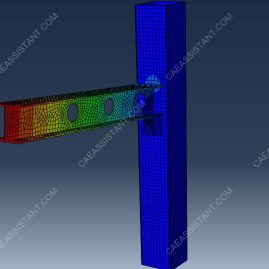
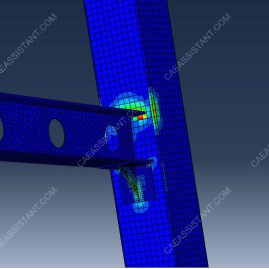
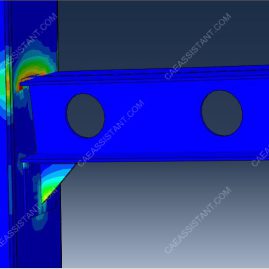
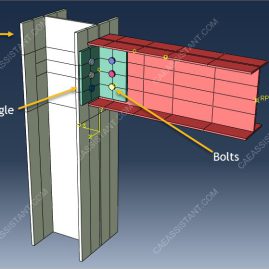
In this tutorial, cyclic loading on a steel beam-column connection with a steel angle and gusset is simulated in Abaqus. The steel beam and box column are modeled as three-dimensional shell parts, while the steel angle and gusset are modeled as three-dimensional solid parts.
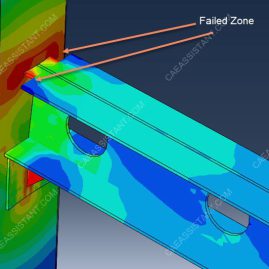
All components use steel material with elastic-plastic behavior and a ductile damage criterion to predict damaged zones. Cyclic loading mainly causes failure at the joint zone, and the damage model captures this behavior effectively. A general static step with a defined time period is applied.
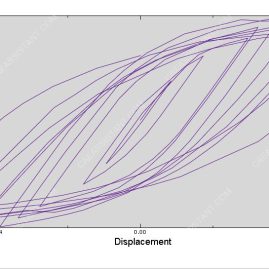
The contact between the steel angle and beam, as well as between the angle and column, is assumed to be perfect, similar to a welded joint. Fixed boundary conditions are applied to the top and bottom edges of the column. Displacement with a defined amplitude protocol is assigned to the beam. A fine mesh is required to accurately predict damage propagation.
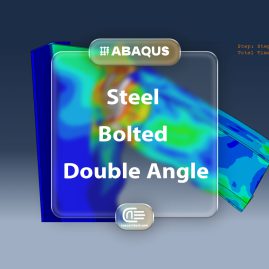
After the simulation, the effect of the steel angle with gusset becomes clear. Due to their stiffness, less damage occurs at the bottom side of the beam. In contrast, significant damage is observed at the top surface of the beam when the steel angle is not present. Results such as stress, strain, and displacement can be obtained, and figures of the outcomes are provided.
Reviews
There are no reviews yet.