


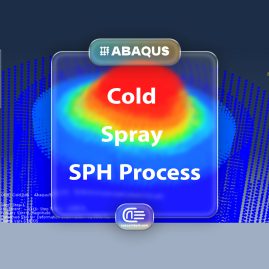
In this tutorial, the cold spray process of ceramic particle impact on a titanium target is simulated using Abaqus.
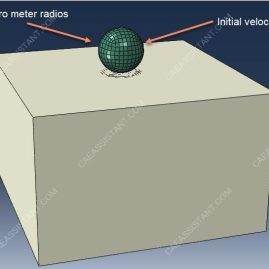
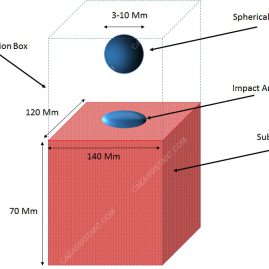
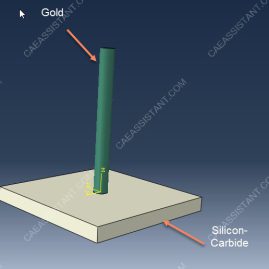
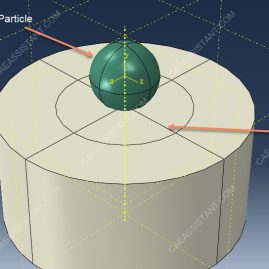
The ceramic impactor is modeled as a three-dimensional sphere with a radius of 40 micrometers, which is the minimum sphere size allowed in Abaqus. The titanium target is also modeled as a three-dimensional part. For simplicity, the target size used in this tutorial is larger than the real physical size. Figures of the assembled parts are shown below.
The titanium material is defined as an elastic-plastic material with Johnson-Cook behavior and Johnson-Cook damage to predict the damaged zone. The Johnson-Cook model is well-suited for simulating deformation under rapid loading. The ceramic material is modeled using the Johnson-Holmquist ceramic model, which accurately represents the behavior of silicon carbide under high-velocity impact.
A dynamic explicit step is applied, with a surface-to-surface contact algorithm and defined contact properties. The titanium target is fixed with boundary conditions, while the ceramic sphere is assigned an initial velocity to act as a projectile.
The mesh is refined in the contact zone to capture the impact response. However, due to the micrometer-scale dimensions, the mesh size cannot be made extremely small, which is a limitation of this modeling approach.
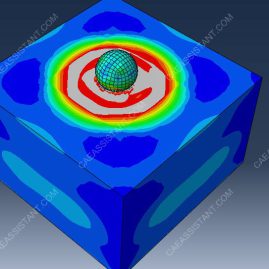
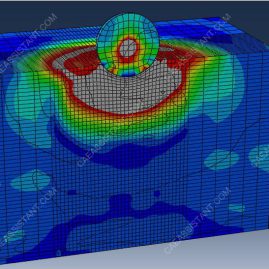
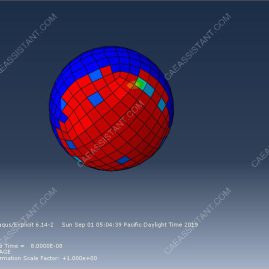
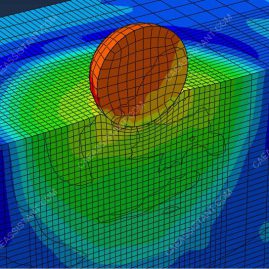
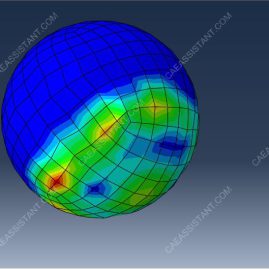
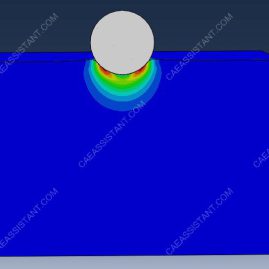
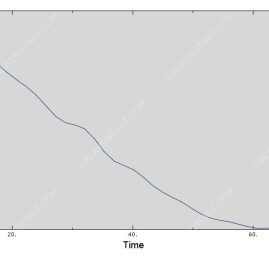
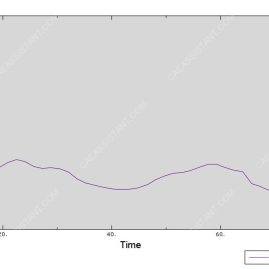
After running the simulation, results such as stress, strain, plastic strain, and damage can be obtained. Figures of these results are provided below.


Reviews
There are no reviews yet.