


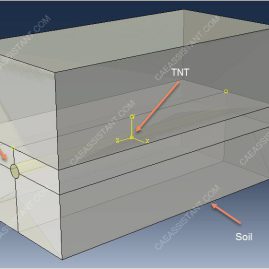
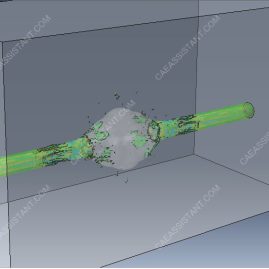
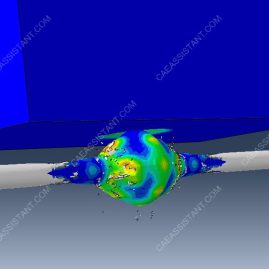
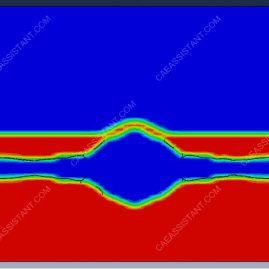
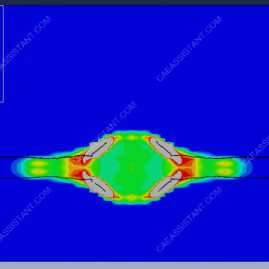
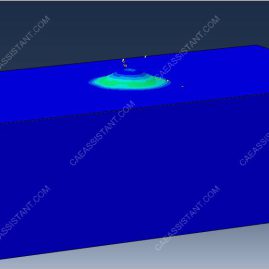
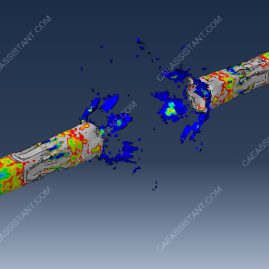
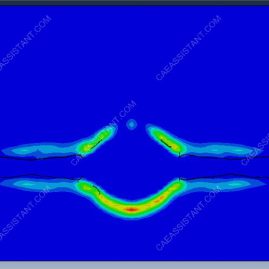
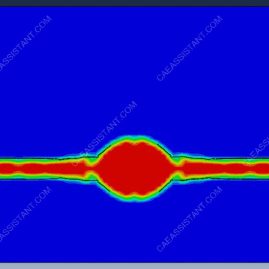
In this tutorial, a CEL simulation of an explosion inside a steel pipe buried in soil is performed using Abaqus. The pipe is modeled as a three‑dimensional shell part. The TNT, soil, and air are modeled as three‑dimensional solid parts. The Eulerian domain is defined as a three‑dimensional Eulerian part.
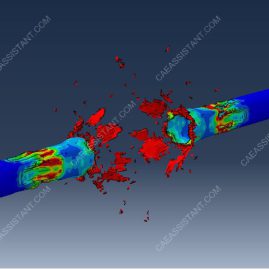
The steel pipe uses an elastic–plastic material model with ductile and shear damage criteria to predict failure after detonation. The TNT is modeled with the JWL equation of state, which converts the chemical energy of the explosion into mechanical pressure. Air is modeled as an ideal gas with viscosity. Soil behavior is defined using Mohr–Coulomb plasticity.
A dynamic explicit step is used because it is suitable for high‑speed events such as explosions. General contact is applied with appropriate contact properties. The ends of the pipe are fixed, and Eulerian boundary conditions are assigned to the Eulerian domain. The volume fraction method is used to track TNT, soil, and air. A fine mesh is required to obtain accurate results.
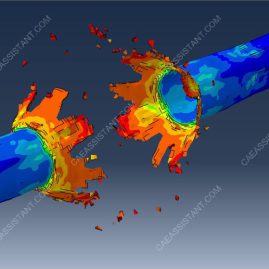
After the simulation, results such as damage, stress, strain, and failure can be extracted. During detonation, the pressure wave from the TNT causes significant damage to the pipe and pushes material into the surrounding soil and air.

Reviews
There are no reviews yet.