


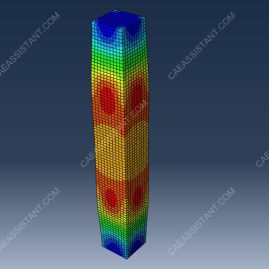
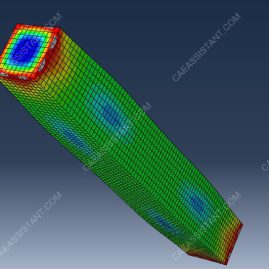
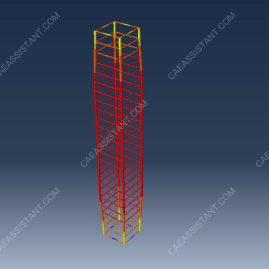
In this tutorial, the axial compression behavior of an Ultra-High-Performance Concrete (UHPC) column is simulated in Abaqus. UHPC is an advanced concrete technology known for its high compressive and tensile strength, ductility, and durability.
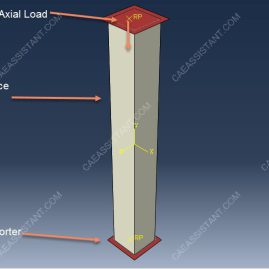
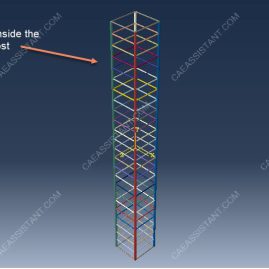
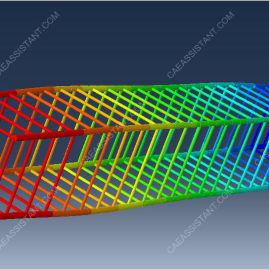
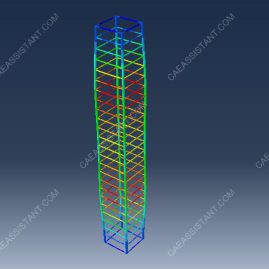
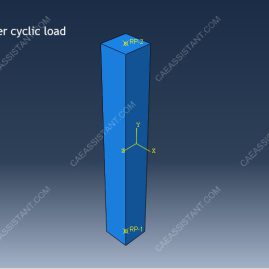
The concrete column is modeled as a three-dimensional solid part. The reinforcing bars are modeled as three-dimensional wire parts embedded inside the column. Two rigid shell bodies are used: one as the support and one as the loading plate.
Steel with an elastic–plastic material model is assigned to the bars. The UHPC material is modeled using the Concrete Damaged Plasticity (CDP) model, which can predict concrete behavior with good accuracy. The material parameters include the modulus of elasticity (E), Poisson’s ratio (ν), and the CDP parameters. In the CDP model, cracked concrete is assigned a constant Poisson’s ratio. Key CDP parameters used are dilation angle (ω), shape factor (Kc), stress ratio rb0/rc0, eccentricity, and viscosity.
A general static step is used with adjusted convergence settings. General contact with defined contact properties is applied. The bars are embedded in the concrete host. The bottom rigid body is fully fixed, while a displacement boundary condition is applied to the top rigid body to create the axial compression load. A fine mesh is recommended to achieve accurate results.
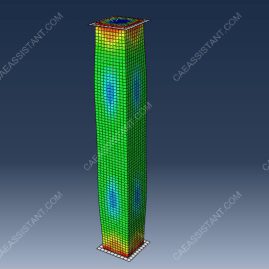
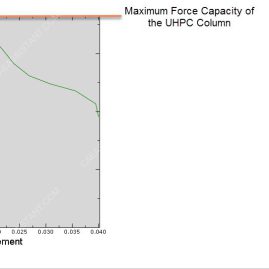
After running the simulation, results such as stress, strain, displacement, and the force–displacement curve can be extracted. The failure zone can also be identified based on the force–displacement response.
Reviews
There are no reviews yet.