


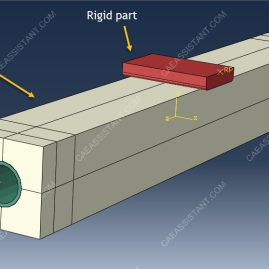
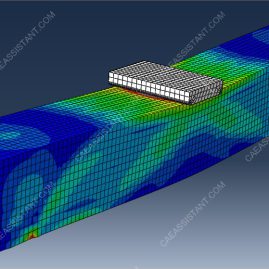
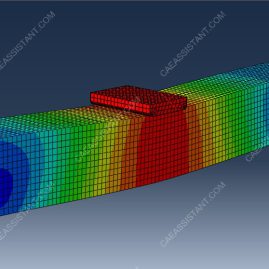
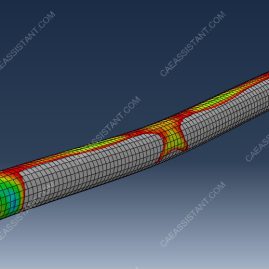
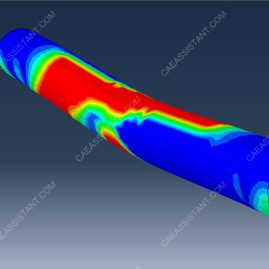
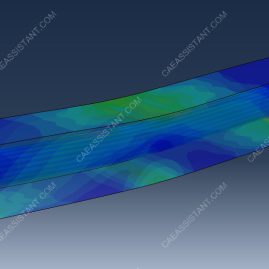
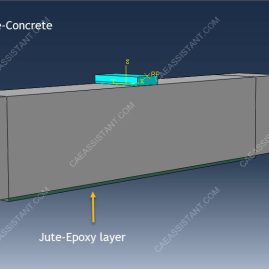
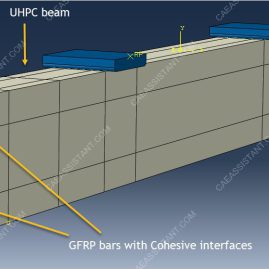
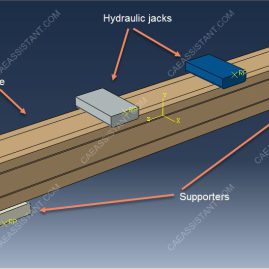
In this tutorial, the static bending behavior of a UHPC beam with a CFRP pipe core is simulated in Abaqus. The concrete beam is modeled as a three‑dimensional solid part, while the CFRP pipe core is modeled as a three‑dimensional shell part. A rigid body is used to apply the loading.
Composite structures are widely used because they offer efficient and reliable performance. Fiber Reinforced Polymer (FRP) materials have become common in civil engineering due to their high strength‑to‑weight ratio, durability, and corrosion resistance. Although concrete is the most common construction material, it has limitations such as low tensile strength and brittleness. Ultra‑High Performance Concrete (UHPC) helps address these issues.
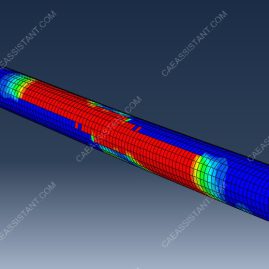
UHPC is modeled using the Concrete Damage Plasticity (CDP) model to capture both tensile and compressive behavior. The CFRP material is defined using lamina elasticity and Hashin’s damage criterion to predict damage during bending.
A general static step is used, with adjustments to improve convergence. Perfect contact is assumed between the CFRP pipe and the inner concrete surface. General contact with friction is applied to all other contact regions. Fixed boundary conditions are assigned to both ends of the UHPC beam, and displacement control is applied to the rigid body to simulate loading. A fine mesh is required to obtain accurate results.
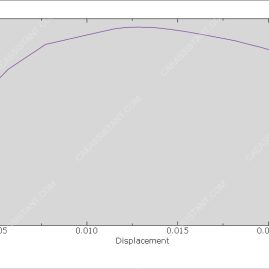
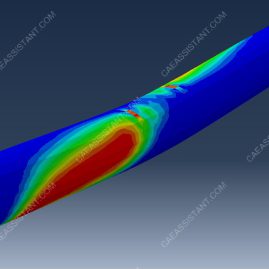
After running the simulation, results such as stress, strain, damage, failure patterns, and the force‑displacement curve are available.


Reviews
There are no reviews yet.