


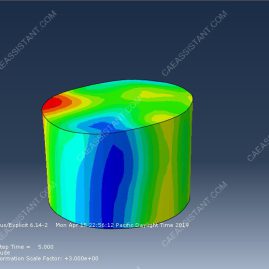
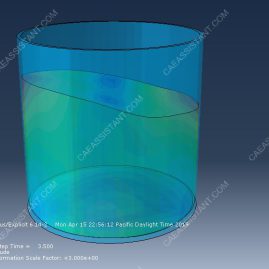
In this tutorial, the water sloshing phenomenon inside a cylindrical tank is investigated using Abaqus. Sloshing can create significant loads on tanks used in seagoing vessels, fuel systems, and liquid cargo containers. These loads may affect the containment system and supporting structures, so understanding sloshing behavior is important for safe and efficient design.
Baffles are often used to reduce sloshing by dissipating kinetic energy and generating vortices in the fluid. However, the damping mechanisms of baffles are not yet fully understood. Liquid sloshing remains a key concern in many engineering fields, including aerospace, civil, nuclear, and marine engineering, as well as in the design of road tankers, ship tanks, storage tanks, and elevated water towers.
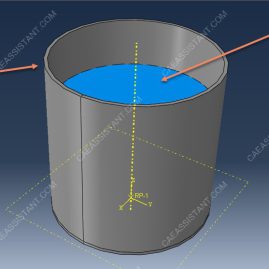
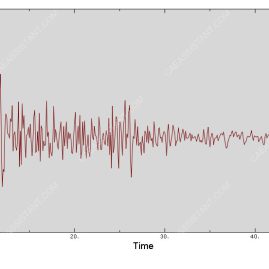
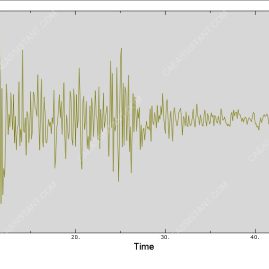
In this model, both the water and the tank are created as three‑dimensional parts. The water material is defined using the Equation of State (Us–Up) with viscosity. A Dynamic Explicit step is used, along with surface‑to‑surface contact interactions. External excitation is applied through two acceleration inputs in the X and Y directions, based on recorded earthquake data.
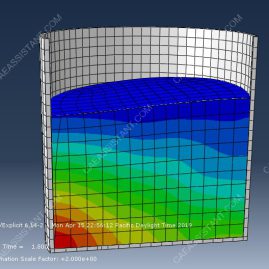
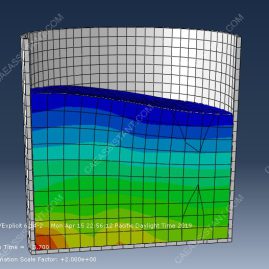
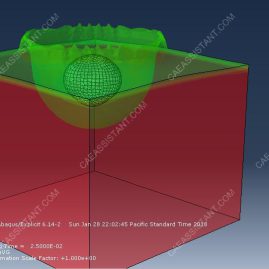
To prevent excessive mesh distortion in the fluid, the ALE (Arbitrary Lagrangian–Eulerian) method is applied to the water domain. The results include several figures showing the sloshing response and deformation patterns.
Reviews
There are no reviews yet.