


In this tutorial, the low-velocity impact response and damage mechanisms of glass fiber aluminium laminates (GLARE) are studied using Abaqus. GLARE is a type of fiber metal laminate widely used in aircraft structures, where low-velocity impacts are common.
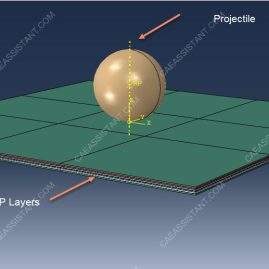
The aim of this work is to investigate the dynamic response and damage characteristics of GLARE under both single and repeated impacts. The laminate model consists of two aluminium plates placed at the top and bottom, and four glass fiber layers in the middle.
For the aluminium plates, the Johnson-Cook plasticity and damage model is applied to predict deformation and failure under a rigid projectile. The glass fiber layers are modeled with engineering constant elasticity and Hashin’s damage criterion for fibers. A dynamic explicit procedure is chosen, as it is suitable for this type of impact analysis.
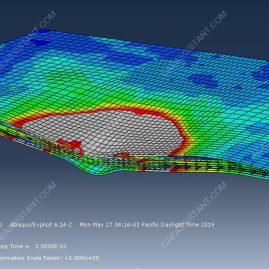
Cohesive behavior is defined at the interfaces, including stiffness, damage, and tangential properties. When the impact energy exceeds the cohesive strength, delamination occurs between the layers. A fine mesh is required in the impact zone to capture accurate results.
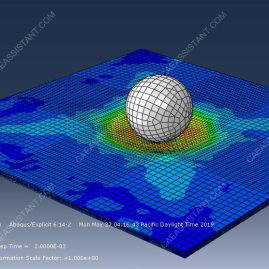
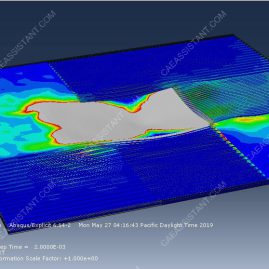
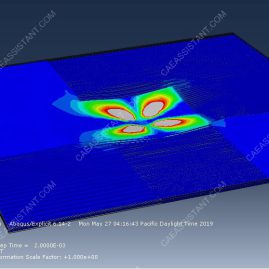
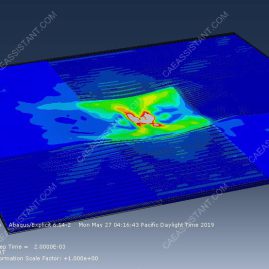
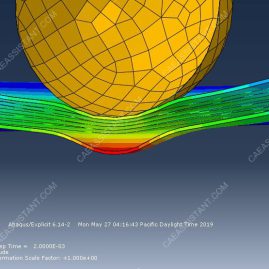
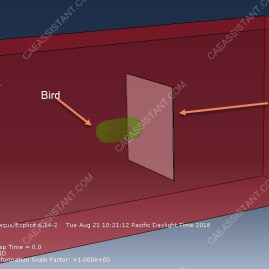
After the simulation, outputs such as stress, strain, and damage distribution can be obtained. Figures of the assembled model and simulation results are provided below.

Reviews
There are no reviews yet.