



An understanding of how brittle and ductile materials respond to hyper-velocity impact is essential for analyzing space debris and micrometeoroid impacts on spacecraft surfaces. Brittle materials commonly exposed in Low Earth Orbit include solar arrays and windows. Laboratory experiments can only reproduce a limited range of impactor parameters such as velocity, diameter, density, shape, composition, and impact angle.
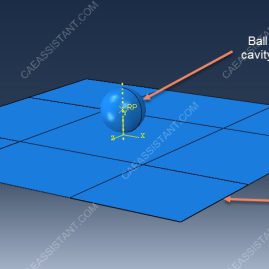
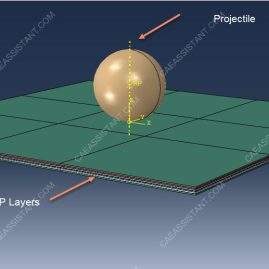
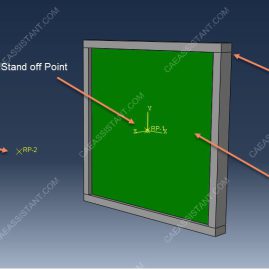
In this simulation, the ball is modeled as a three-dimensional shell part, while the glass is modeled as a solid part with a thickness of 0.5 mm. The ball is assigned a hyperelastic material model. For the glass, a suitable material model is required to capture its behavior under high pressure and high strain rate conditions.
The impact is a dynamic process, so the dynamic explicit procedure is used. Contact is defined as surface-to-surface with friction. To represent the gas inside the ball, the Fluid Cavity technique is applied, using molar heat capacity and molecular weight as input parameters.
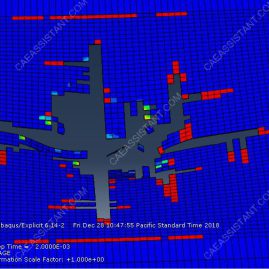
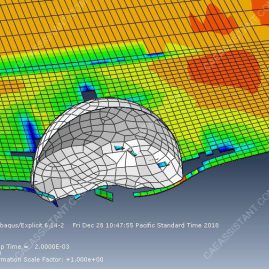
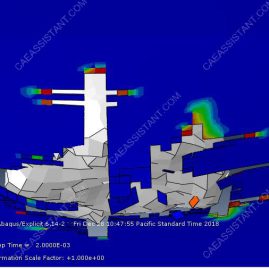
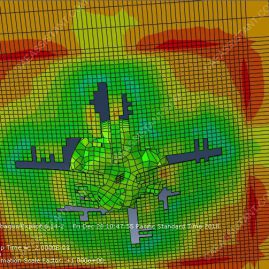
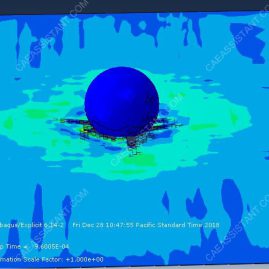
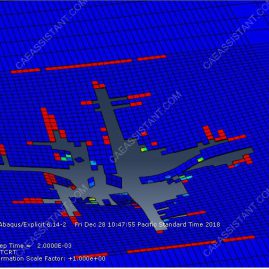
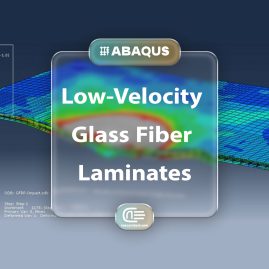
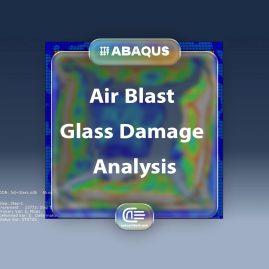
The glass requires a fine mesh to accurately capture its response under impact. Therefore, smaller elements are used in the impact zone. During the simulation, glass failure is observed, while the ball undergoes significant deflection. Figures of the assembly and results are provided below.
Reviews
There are no reviews yet.