


Hydroforming is a metal forming process used to shape materials such as steel, stainless steel, copper, aluminum, and brass. It is a cost‑effective method that uses highly pressurized fluid to form metal into complex shapes. There are two main types of hydroforming: sheet hydroforming and tube hydroforming.
In sheet hydroforming, a single die and a flat metal sheet are used. High‑pressure water pushes the sheet into the die to create the final shape. In tube hydroforming, a metal tube is placed between two die halves and expanded by internal fluid pressure. Hydroforming often replaces traditional stamping and welding of two separate halves. It improves efficiency, reduces welding, and allows the creation of complex geometries. Hydroformed parts are lightweight, strong, and have high‑quality surfaces. They also offer lower production costs and a better stiffness‑to‑weight ratio.
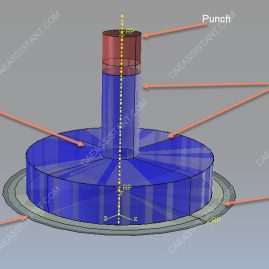
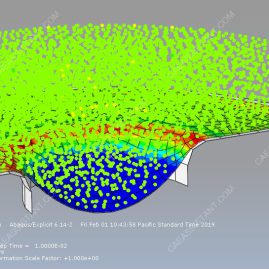
This tutorial focuses on sheet hydroforming. The model includes all assembled parts, with aluminum used for the sheet. Water is defined using the Us–Up equation of state. The analysis is performed with a Dynamic Explicit step and surface‑to‑surface contact. Smooth Particle Hydrodynamics (SPH) is used to represent the fluid behavior.
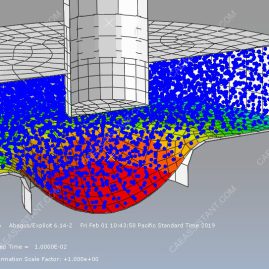
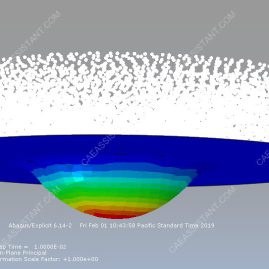
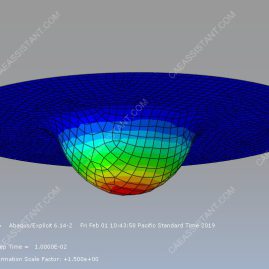
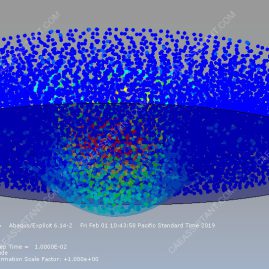
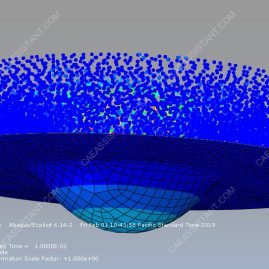
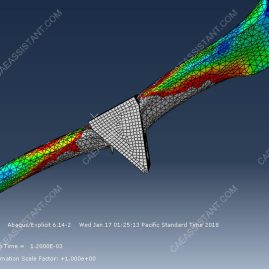
During the simulation, the punch moves downward into the water. The water then transfers pressure to the sheet, causing it to deform. After a short time, the sheet takes its final hydroformed shape. Example result figures are shown below.


Reviews
There are no reviews yet.