

Sandwich panels are widely used in lightweight construction, especially in aerospace industries, because of their high strength-to-weight ratio and stiffness. During service, these panels are often subjected to impacts from various sources. Examples include debris propelled at high velocity during aircraft takeoffs and landings, tools accidentally dropped during maintenance, or collisions with birds.
Although visual inspection may show little damage, significant internal damage can occur between the impacted facesheet and the core. This hidden damage can reduce the structural stiffness and strength of the panel, which may worsen under further loading. For this reason, the impact behaviour of sandwich panels has received increasing attention.
Finite element modelling (FEM) is a popular and cost-effective method for studying sandwich structures. To improve efficiency in numerical analysis, the complex cellular core of a sandwich panel is often replaced with an equivalent continuum model. In this approach, the panel is analysed using effective material properties rather than its detailed cellular geometry. Several experimental and analytical techniques have been proposed to predict these effective properties based on the geometry and material of the core. For example, modified classical laminate theory has been applied to unit cells to derive equivalent elastic rigidities for honeycomb cores. However, deriving effective elastic constants can be tedious or even impossible for complex sandwich constructions, and formulations for one type of core may not apply to others.
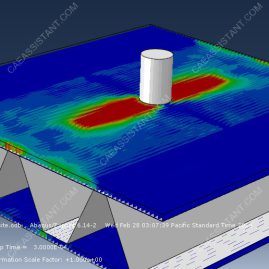
In this simulation, the projectile is modelled as a three-dimensional steel part. The honeycomb core and its two facesheets are modelled as three-dimensional aluminium shells. Johnson-Cook plasticity and damage models are applied to both the projectile and the sandwich panel. A dynamic explicit procedure is used, which is appropriate for high-velocity impact analysis.
The contact between the honeycomb core and the facesheets is assumed to be perfect. The contact between the projectile and the upper facesheet is defined as surface-to-surface with specific contact properties. Due to the projectile’s high initial velocity, clear deformation and damage occur in the sandwich panel. The Johnson-Cook damage parameter is available after the impact, providing insight into the failure behaviour.
Figures of the assembled parts and simulation results are shown below.



Reviews
There are no reviews yet.