


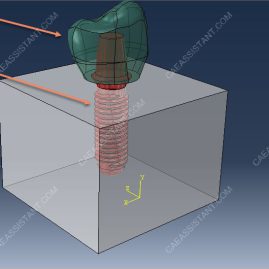
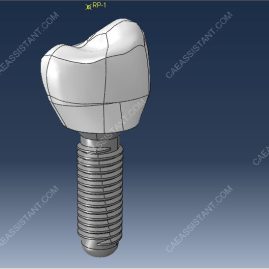
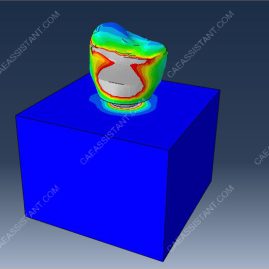
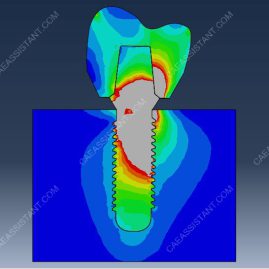
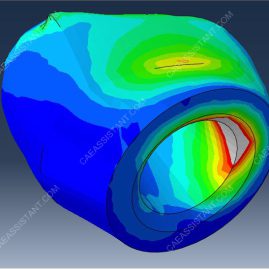
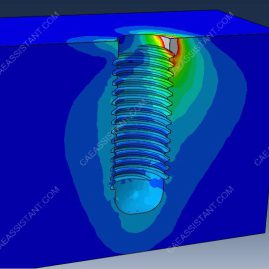
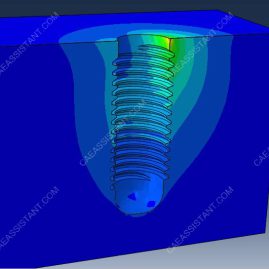
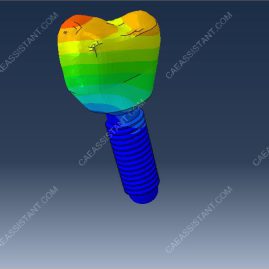
In this tutorial, the simulation of a dental implant interacting with the mandible bone under dynamic loading in Abaqus is presented. The crown, abutment, and mandible bone are modeled as three-dimensional parts.
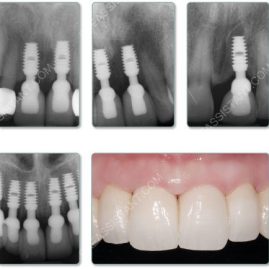
Dental implants are metal posts or frames that are surgically placed into the jawbone. They support artificial teeth by fusing to the bone, which provides stable and secure attachment. As a result, dentures, bridges, and crowns mounted on implants do not slip during eating or speaking. This stability also makes them feel more natural than conventional dental restorations. Figures of the real and assembled parts are shown in the tutorial.
The crown is defined with a ceramic material that includes elastic–plastic behavior and a ductile damage criterion. The abutment (root) is modeled using titanium with elastic–plastic properties and Johnson–Cook damage. The mandible bone is also assigned elastic–plastic behavior.
A dynamic explicit procedure is used to apply the dynamic load. The general contact algorithm with appropriate contact properties defines the interactions between all parts. Boundary conditions are applied to the mandible, and a concentrated force with a smooth amplitude curve is applied to the crown. Because of the geometric complexity, a fine mesh is required.
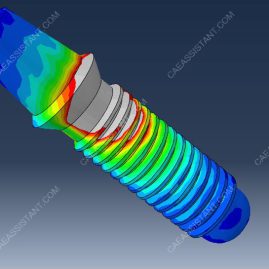
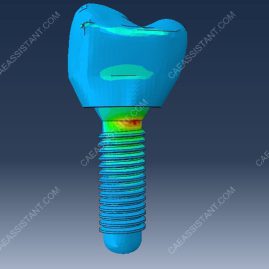
During the analysis, the applied force generates stress in the assembly, and critical stress zones can be identified. The tutorial includes several result figures for reference.


Reviews
There are no reviews yet.