


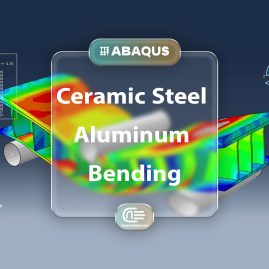
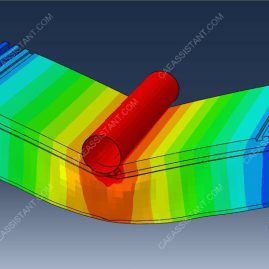
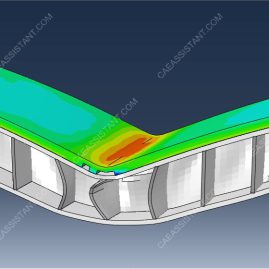
In this tutorial, the numerical simulation of three-point bending of a composite panel (ceramic–steel–aluminum) in Abaqus is presented.
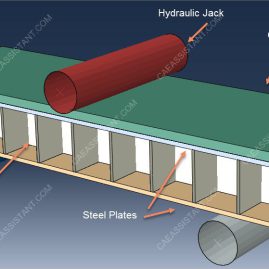
The ceramic and steel plates are modeled as three-dimensional solid parts.
The aluminum honeycomb core is modeled as a three-dimensional shell part.
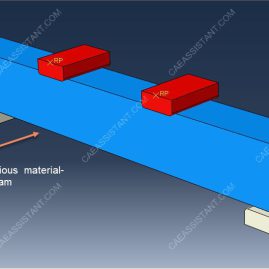
Three rigid bodies are used to represent the hydraulic jack and boundary supports.
Composite sandwich structures are widely used in engineering applications because of their lightweight design, high stiffness, good damage tolerance, and excellent energy absorption capacity.
For material modeling:
Steel is defined with elastic properties and Johnson–Cook plasticity. This model is suitable for high strain-rate deformation of metals and is a specific form of Mises plasticity with analytical hardening and rate dependence.
Ceramic is modeled using the Johnson–Holmquist model, which assumes progressive damage growth with plastic deformation.
Aluminum core is modeled as an elastic–plastic material.
The analysis uses a dynamic explicit step, which is appropriate for impact and bending simulations. Perfect contact is assumed among deformable parts, with general contact including friction. Surface-to-surface contact is defined between the rigid bodies and the ceramic/steel plates.
Boundary conditions:
The two bottom rigid bodies are fixed.
A displacement is applied to the top rigid body to simulate loading.
A fine mesh is required to achieve accurate results.
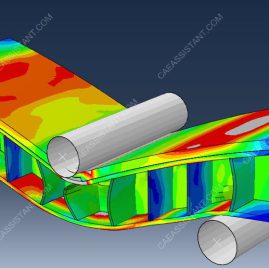
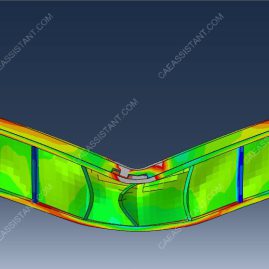
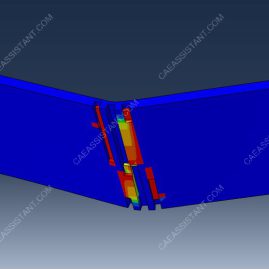
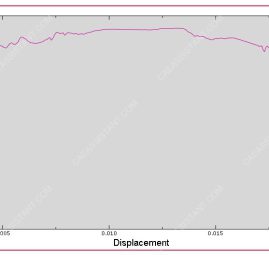
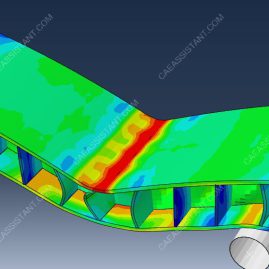
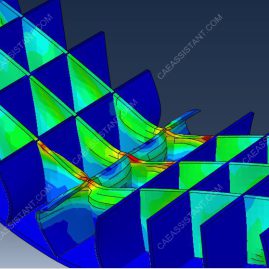
After the simulation, results such as ceramic plate failure, aluminum core crushing, stress and strain distribution, and the force–displacement diagram can be obtained. Figures of the assembled model and results are shown below.


Reviews
There are no reviews yet.