



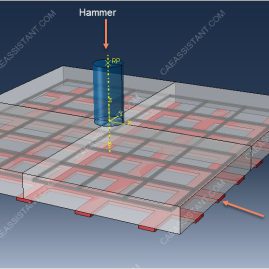
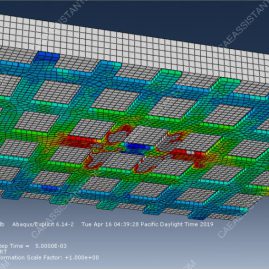
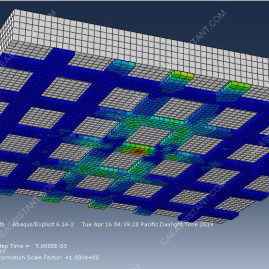
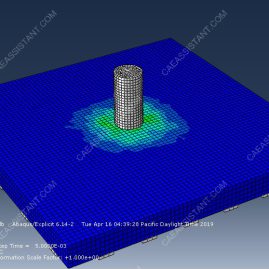
In this tutorial, the low-velocity impact behavior of reinforced concrete (RC) slabs strengthened with CFRP strips is investigated using Abaqus.
RC slabs are common structural elements in construction. They are typically designed to withstand vertical static and dynamic loads. However, impact loads—such as those caused by falling objects or collisions—are often neglected in standard design practices. Understanding the behavior of RC slabs under impact loading remains a challenging research area, driven by applications in safety-critical structures. These include buildings exposed to accidental impacts, bridges and offshore facilities facing vehicle or ship collisions, and high-security structures like military bunkers or nuclear plants.
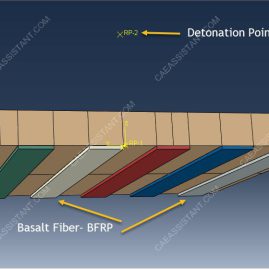
To simulate this behavior, the concrete slab is modeled as a 3D solid using the Concrete Damaged Plasticity (CDP) material model. CFRP strips are modeled as 3D shell elements with elastic properties combined with Hashin’s damage criteria. Reinforcement bars are represented as wire elements with an elastic-plastic material model.
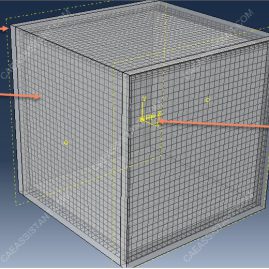
The simulation uses a dynamic explicit step with surface-to-surface contact. The interface between concrete and CFRP is defined as perfect contact, while the bars are embedded within the concrete using an embedded region constraint. Fixed boundary conditions are applied to the slab, and an initial velocity is assigned to the rigid impactor.
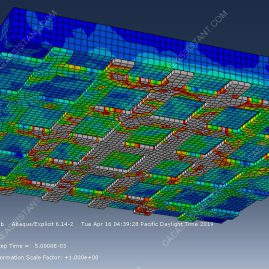
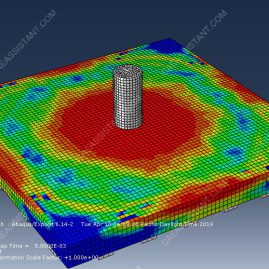
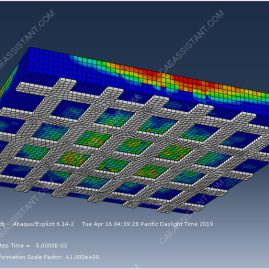
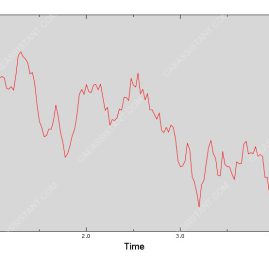
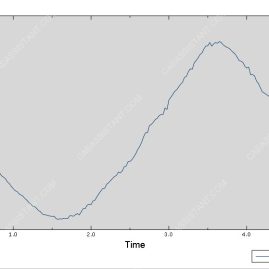
Mesh quality significantly influences the propagation of tensile and compressive damage. Simulation results, including damage patterns and deformation, are illustrated in the figures below.


Reviews
There are no reviews yet.