


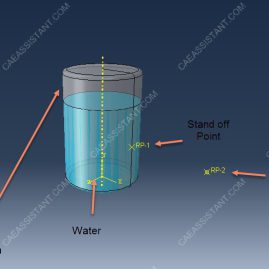
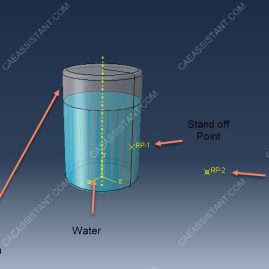
In this tutorial, the behavior of cylindrical steel drums under blast loading conditions has been studied using the SPH (Smoothed Particle Hydrodynamics) method in Abaqus.
Over the past few decades, several major industrial accidents have occurred worldwide. Blast waves generated by detonation show a sudden rise in pressure above atmospheric levels, reaching a peak overpressure (free-field or side-on). This peak gradually decays back to ambient pressure, followed by a small negative phase.
Deflagration typically produces a blast wave with a slower rise to peak overpressure, followed by a decay and a negative phase of similar scale to the positive phase. In contrast, detonation generates a blast wave with a higher peak overpressure but a shorter positive duration. Under certain conditions, deflagration can transform into detonation, especially in highly congested regions.
When a detonation blast wave strikes a surface, it reflects. The magnitude of the reflected overpressure depends on the peak incident value and the angle of incidence. For deflagration, the reflected overpressure is more closely related to the incident wave parameters and the dimensions of the target. Unlike detonation, deflagration does not produce a significant enhancement of reflected overpressure at the same peak incident level.
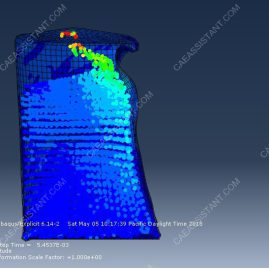
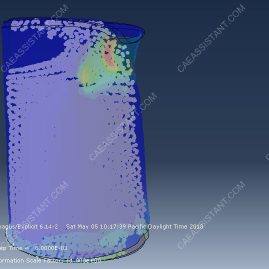
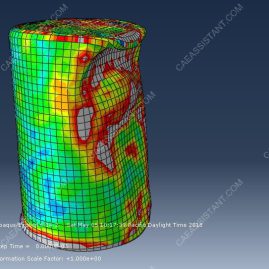
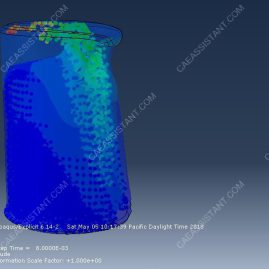
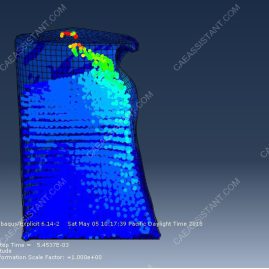
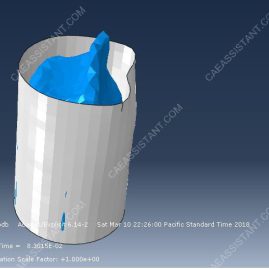
During the analysis, the blast wave pressure caused large deformations in the drum. As a result, the water inside the tank exhibited wave-like motion similar to a sloshing phenomenon. To model the drum behavior under blast loading, the Johnson-Cook plasticity and damage model was applied. For the water, the Us–Up linear equation of state was used.
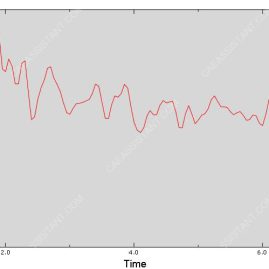
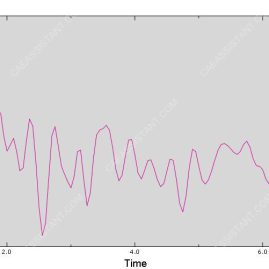
Figures of the simulation results are shown below.

Reviews
There are no reviews yet.