

In this tutorial, the behavior of a masonry wall under a coupled Eulerian–Lagrangian (CEL) explosion in Abaqus is simulated. Numerical simulations are widely used to study dynamic problems related to explosions, including gaseous or condensed charge detonations and the resulting pressure wave propagation through air. These methods make it possible to evaluate the direction of pressure waves and their effects on different structures.
For decades, researchers have combined real-life experiments with numerical simulations to better understand blast phenomena and to develop reliable modeling methods. The response and failure of a structure subjected to an explosion depend strongly on the type and strength of the explosive charge. Changing these parameters leads to fundamentally different outcomes. This study highlights the motivation for investigating such problems and presents the current state of the art in this field.
In the simulation:
Concrete bricks are modeled as three-dimensional solid parts.
TNT is modeled as a solid Eulerian domain.
The Johnson–Holmquist model is used to represent the behavior of concrete blocks under high strain rates.
The JWL equation of state is applied to model TNT behavior.
A dynamic explicit procedure with general contact is used.
Mortar behavior is modeled with cohesive properties, including damage evolution and tangential friction, applied to block contact surfaces.
Proper boundary conditions are applied to the bottom concrete beam.
The TNT location and amount are defined using the volume fraction method.
A fine mesh is applied to improve accuracy of the results.
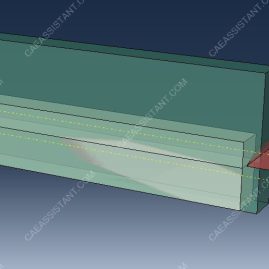
After the simulation, key outputs such as brick damage variables, stress distribution, TNT wave propagation, and pressure fields can be obtained. Figures of the assembled parts and results are provided in the tutorial.

Reviews
There are no reviews yet.