


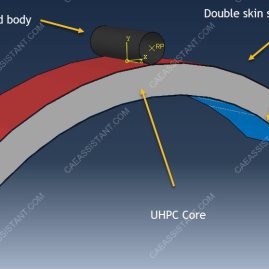
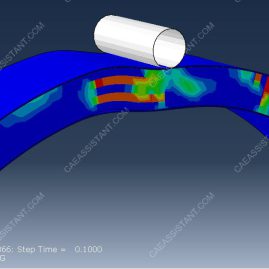
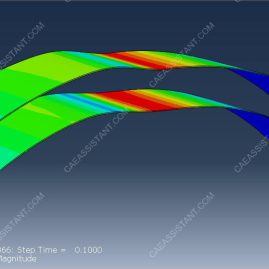
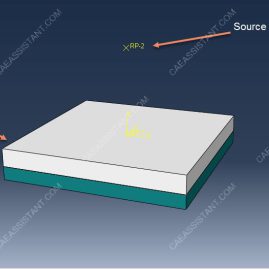
In this tutorial, the bending behavior of a curved steel–UHPC–steel double-skin composite panel is simulated in Abaqus. The UHPC core is modeled as a three‑dimensional solid part, while the steel skins are modeled as three‑dimensional shell parts.
Steel–UHPC–steel double-skin composite panels consist of two external steel plates filled with a UHPC concrete core. To accurately capture the concrete response, it is important to use an appropriate material model for both compressive and tensile behavior. Abaqus provides several concrete models for nonlinear analysis. In this study, the Concrete Damage Plasticity (CDP) model is used to define the UHPC behavior under compression and tension. Tensile and compressive damage variables are included to represent crack initiation and propagation.
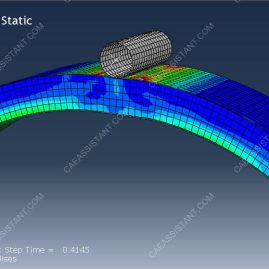
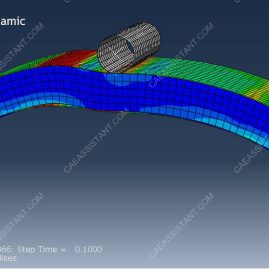
For the steel skins, an elastic–plastic material model with a ductile damage criterion is applied. Two separate simulations are performed: one using the Static General solver and one using the Explicit solver. The difference between the two solvers is small for this problem.
Surface‑to‑surface contact with defined contact properties is assigned between the rigid body and the top steel skin. The interaction between the UHPC core and the steel skins is modeled as surface‑to‑surface contact in the static analysis and as general contact with cohesive behavior in the explicit analysis.
Both ends of the panel are fixed, and a displacement load is applied to the top rigid body. A fine mesh is required to obtain accurate results.
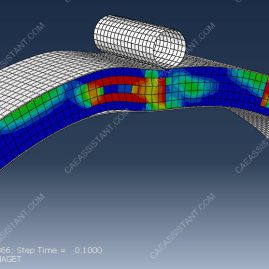
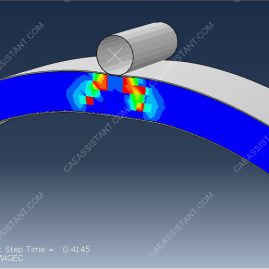
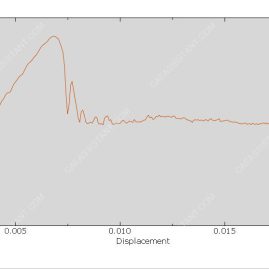
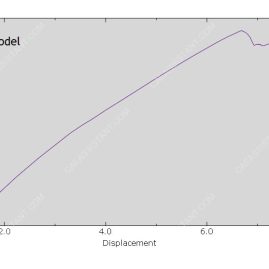
After completing both simulations (static and explicit), results such as stress, strain, tensile and compressive damage, and the force–displacement curve are available. Figures from both simulations are shown below.

Reviews
There are no reviews yet.