


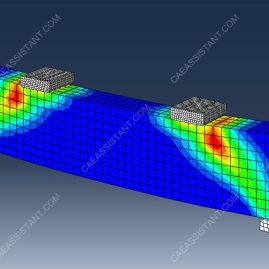
In this tutorial, the numerical simulation of Ultra-High-Performance Concrete (UHPC) under four-point bending in Abaqus is presented. Concrete is the most widely used material in construction, but it has limitations such as low tensile strength and brittleness. UHPC, a modern high-strength concrete, can overcome these issues. It has a compressive strength greater than 21.7 ksi (150 MPa) and a flexural strength greater than 0.72 ksi (10 MPa) at 28 days.
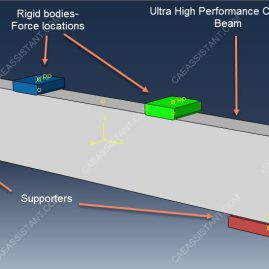
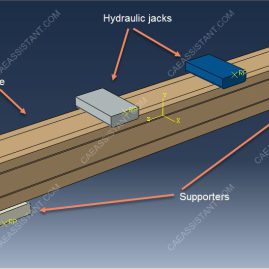
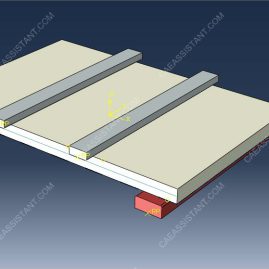
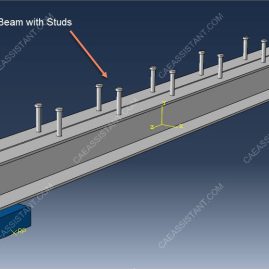
The concept of UHPC was first introduced by Richard and Cheyrezy in the early 1990s at Bouygues Laboratory in France. In this simulation, the concrete beam is modeled as a three-dimensional solid part. The assembled model can be seen in the figures provided. Using commercial finite element (FE) software, UHPC structures can be studied effectively. A three-dimensional FEM simulation is applied to model the failure process.
The Concrete Damaged Plasticity (CDP) model is used to represent the behavior of the concrete beam. The material parameters include the modulus of elasticity (E), Poisson’s ratio (ν), and CDP-specific values. For cracked concrete, Poisson’s ratio is kept constant. The main CDP parameters are dilation angle (ω), shape factor (Kc), stress ratio (rb0/rc0), eccentricity, and viscosity parameter.
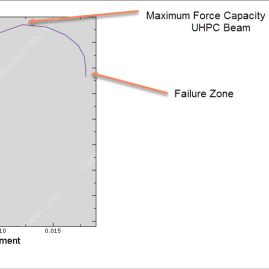
A general static step is applied, with adjustments to the convergence model, to obtain a clear force-displacement diagram. Surface-to-surface contact is defined between the concrete beam and rigid bodies. The two bottom rigid bodies are fixed, while displacement boundary conditions are applied to the two top rigid bodies. A fine mesh is required to achieve accurate results.
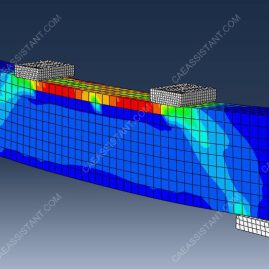
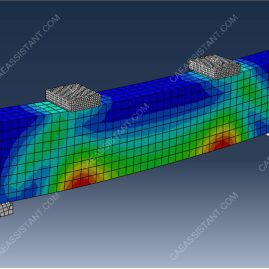
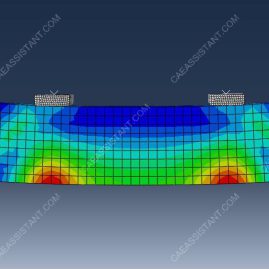
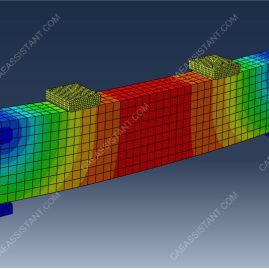
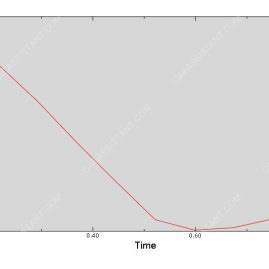
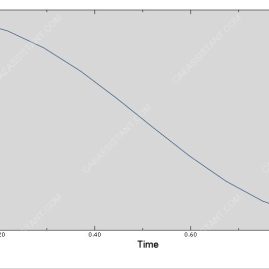
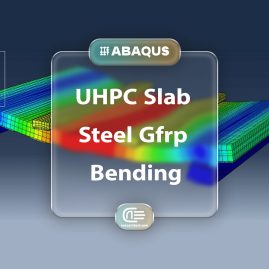
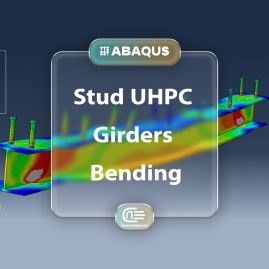
After the simulation, results such as stress, strain, displacement, and the force-displacement diagram can be obtained. Figures of these results are shown below.
Reviews
There are no reviews yet.