


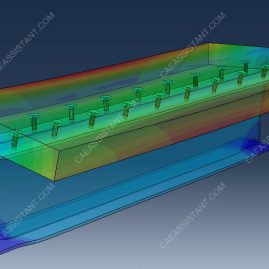
In this tutorial, the simulation of an air blast load on a composite beam (UHPFRC–steel beam with shear studs) in Abaqus is investigated.
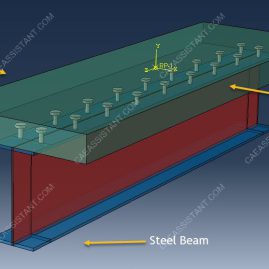
The Ultra-High-Performance Fiber-Reinforced Concrete (UHPFRC) is modeled as a three-dimensional solid part.
The shear stud is modeled as a three-dimensional solid part.
The steel beam is modeled as a three-dimensional shell part.
The assembled parts are shown in the figure below.
UHPFRC improves durability, service life, and structural performance. In recent decades, three major advances in cementitious composites have been achieved:
Higher compressive strength
Improved ductility
Enhanced workability
These improvements resulted from granular packing optimization, the development of Fiber-Reinforced Concrete (FRC), and better understanding of material rheology. Advances in concrete flow models (such as Bingham fluid flow and stress growth methods) led to the development of Self-Compacting Concrete (SCC), and later to UHPC and UHPFRC.
For the simulation:
Concrete Damaged Plasticity is used to model the UHPFRC beam under blast load.
Johnson-Cook hardening and damage is applied to model the steel stud and beam under severe blast conditions.
A dynamic explicit step is chosen, which is suitable for blast analysis.
General contact with defined contact properties is used.
Contacts between studs and UHPFRC are defined using either surface-to-surface contact or embedded constraints.
The CONWEP blast load procedure is selected to apply the explosive load.
Fixed boundary conditions are assigned to both ends of the beam.
A fine mesh is required to obtain accurate results.
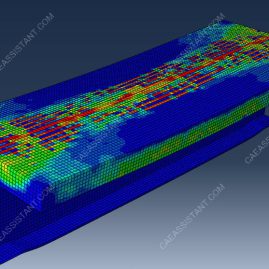
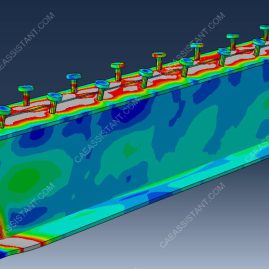
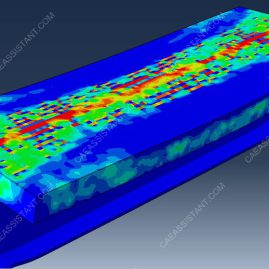
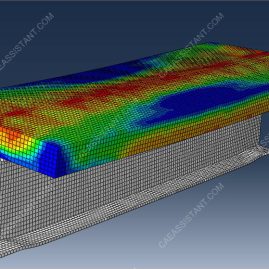
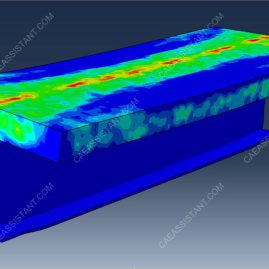
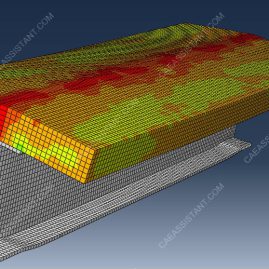
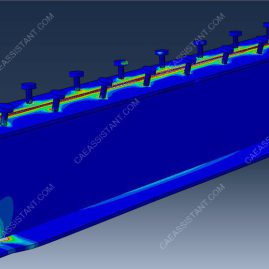
After the simulation, results such as stress, strain, tensile damage, and deformation are available. Figures of these results are shown below.
Reviews
There are no reviews yet.