


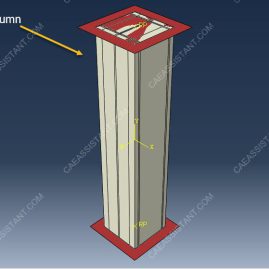
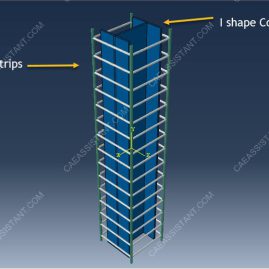
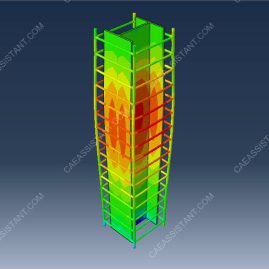
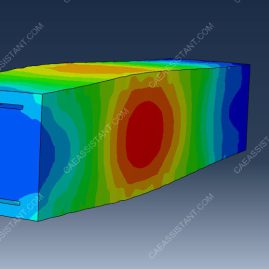
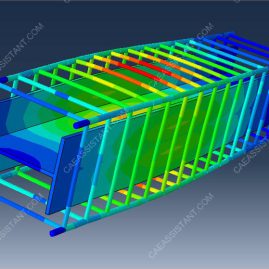
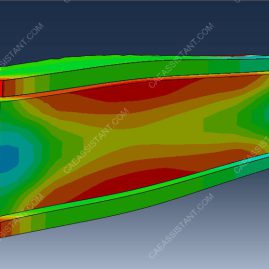
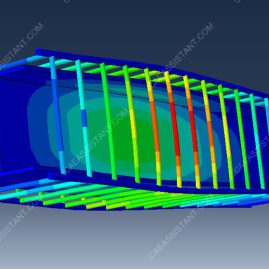
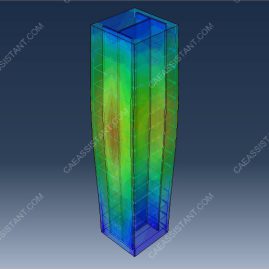
In this tutorial, a compression test of an encased steel–UHPC composite column is simulated using Abaqus. The UHPC column is modeled as a three‑dimensional solid part. The I‑shaped steel section is also modeled as a three‑dimensional solid part. Steel bars and steel strips are created as three‑dimensional wire parts. Figures of the assembled model are shown below.
Composite columns combine structural steel and concrete. They may contain steel sections inside concrete or concrete inside steel sections. These systems use steel shapes, pipes, or tubes—with or without reinforcement—to resist axial compression or combined axial and bending loads. The concrete and steel components work together through contact and friction to carry external loads.
Composite columns offer economic benefits and can carry high loads with smaller cross‑sections compared to conventional columns. They also provide improved fire and corrosion resistance. Structural steel contributes high strength, ductility, and stiffness, which increases load‑carrying capacity. Concrete is widely used in construction, but it has limitations such as low tensile strength and brittleness. Ultra‑High Performance Concrete (UHPC), an advanced concrete material, helps overcome these issues.
In this simulation, the Concrete Damaged Plasticity model is used to define UHPC behavior. Steel behavior is defined using an elastic‑plastic material model with a ductile damage criterion. A general static step is applied with adjustments to improve convergence. General contact with friction is used for all contact regions. The embedded region constraint is assigned to the bars and strips inside the UHPC host. Perfect contact is defined between the UHPC and the steel section.
A fixed boundary condition is applied at the bottom of the column, and the load is applied to a rigid body at the top. A fine mesh is used to ensure accurate results.
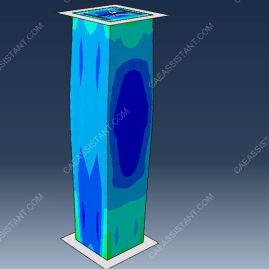
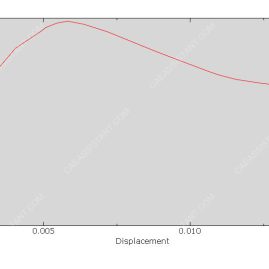
After the simulation, results such as stress, strain, damage, and the force–displacement curve are available. Figures of the assembled parts are shown below.


Reviews
There are no reviews yet.