


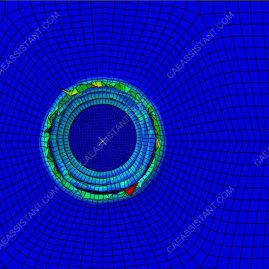
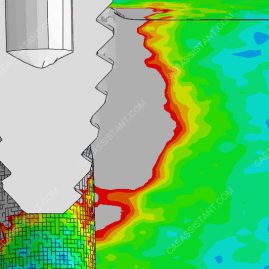
In this tutorial, the simulation of dental implant insertion in Abaqus is presented. Successful osseointegration refers to the stability of an implant after integration with the bone. This stability is described by two terms: primary stability and secondary stability.
- Primary stability is the mechanical engagement of the implant immediately after insertion.
- Secondary stability results from long-term bone regeneration and remodeling, which is a biological process.
These two types of stability are closely related. Poor primary stability is one of the main causes of implant failure.
The finite element method (FEM) is widely used to analyze stresses and investigate the biomechanical behavior of bone–implant rehabilitation components. FEM allows researchers to simulate mechanical interactions that are otherwise very difficult to study experimentally, either in vitro or in vivo. It also enables the application of different loading configurations and the evaluation of displacement and stress levels in the tooth, prosthesis, implant, and bone.
In this model:
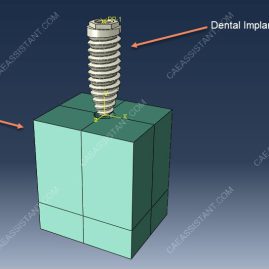
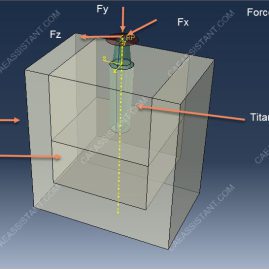
- The implanted root is created as a three-dimensional part and imported into Abaqus due to its complexity.
- The implant is assumed to be a rigid body.
- The mandible bone is modeled as a three-dimensional solid part.
- Titanium is used as the implant material.
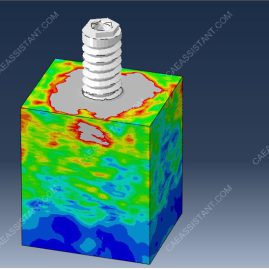
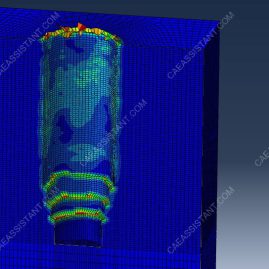
- The mandible bone is defined as an elastic material with Johnson-Cook plasticity and Johnson-Cook damage evolution, which can predict bone damage and failure during insertion.
The analysis uses a dynamic explicit step with a mass-scaling technique.
- Interaction is defined as general contact, with internal damage considered through input file capability.
- A rigid body constraint is applied to the implant.
- The mandible is fixed with boundary conditions.
- Axial displacement with amplitude and rotational velocity is applied to the implant.
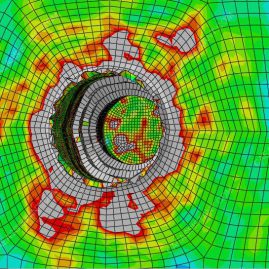
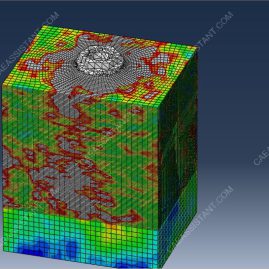
A fine mesh is required to achieve accurate performance and reliable results.
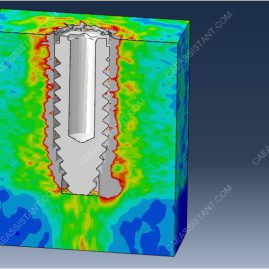
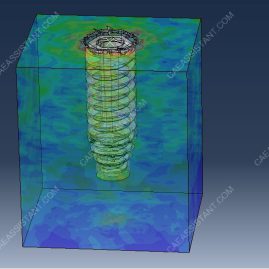
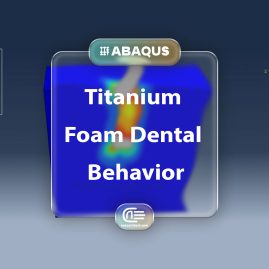
After the simulation, results such as stress, strain, damage, and pressure can be obtained. Figures of the model and results are shown below.

Reviews
There are no reviews yet.