


The finite element method (FEM) is widely used to model complex physical phenomena. Its interdisciplinary applications are growing, especially in the analysis of mechanical properties of modern materials. In dentistry and bioengineering, FEM is applied to evaluate stress levels and verify strength hypotheses in bone tissues. This helps in designing and optimizing dental reconstruction materials, such as crowns or crown-root fillings, and in assessing the risk of treatment failure that could damage dental tissue or filling materials. Numerical simulations using FEM can serve as preclinical tests, supporting biomechanical design and optimization of dental fillings.
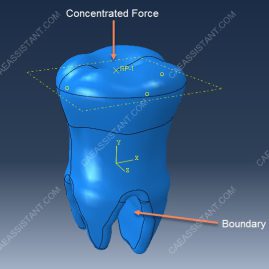
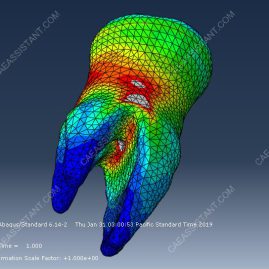
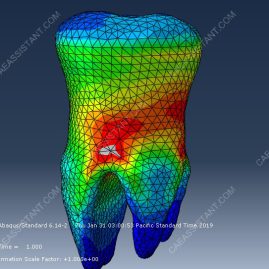
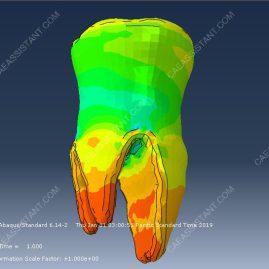
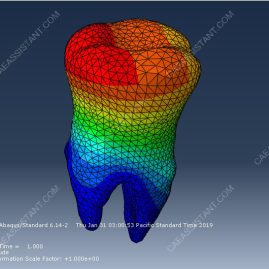
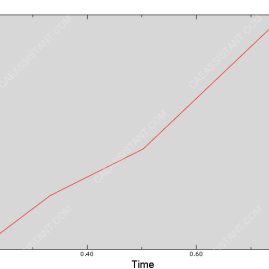
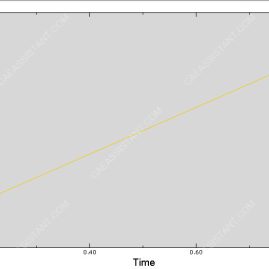
In this tutorial, a finite element simulation of a human tooth under static load is presented. Abaqus cannot directly create complex geometries such as teeth or skulls, so the tooth model is imported into Abaqus as a SAT file. The enamel material properties are assigned to the tooth. A general static step is used to apply a concentrated force, and fixed boundary conditions are applied to the base of the tooth. During the simulation, areas of high stress are clearly visible, along with contour plots and diagrams available in the visualization module. Figures of the assembled part and simulation results are shown below.


Reviews
There are no reviews yet.