



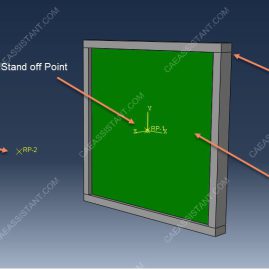
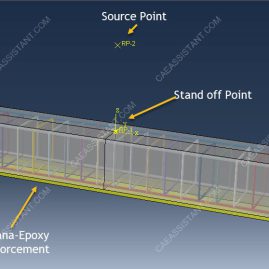
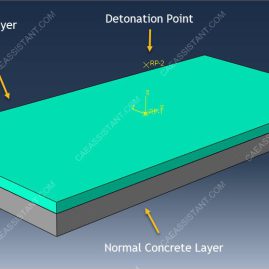
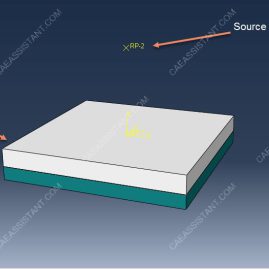
In this tutorial, the finite element simulation of an air blast explosion on glass using Abaqus damage analysis is presented. The glass and frame are modeled as three-dimensional parts, as shown in the assembly figure.
The steel frame is defined with an elastic–plastic material model using the Johnson-Cook damage criterion. For the glass material, Abaqus provides several modeling options, including elastic properties (shear modulus), Drucker-Prager plasticity, ductile damage criterion, and equation of state. By combining these parameters, Abaqus can generate meaningful results for glass behavior. Another approach is to use a VUMAT subroutine or an embedded subroutine in the input file, which can provide more accurate results.
A dynamic explicit procedure is applied, with perfect contact defined between the glass and frame. The blast load is modeled using the CONWEP air blast technique, which applies pressure directly on the glass surface. Fixed boundary conditions are assigned to the frame.
Mesh quality plays a critical role in achieving accurate results. Therefore, a fine mesh is recommended for the glass component.
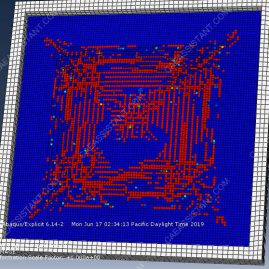
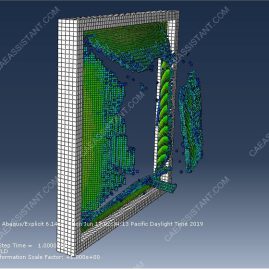
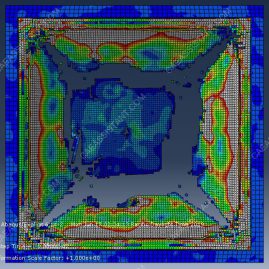
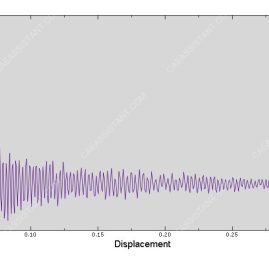
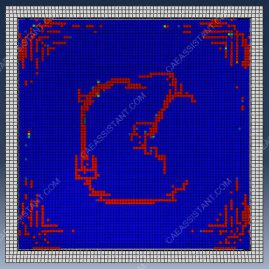
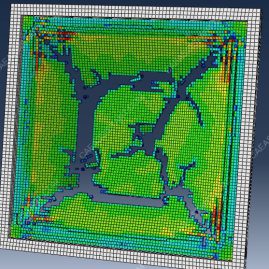
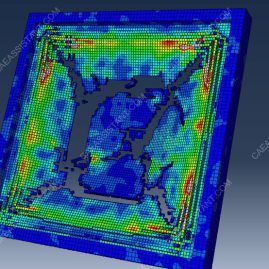
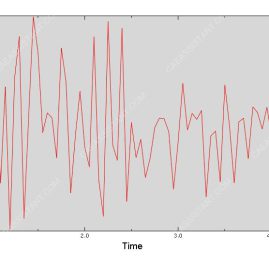
After running the simulation, various results can be obtained, such as the damage variable for glass, stress distribution, strain, and pressure. Figures of these results are shown below.


Reviews
There are no reviews yet.