


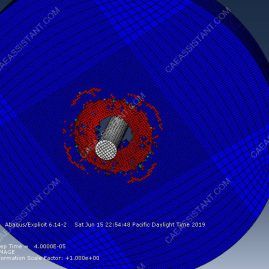
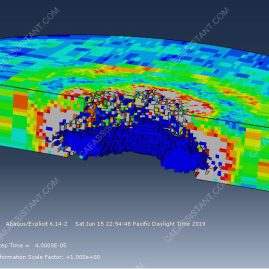
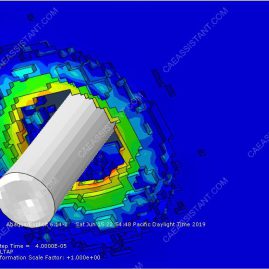
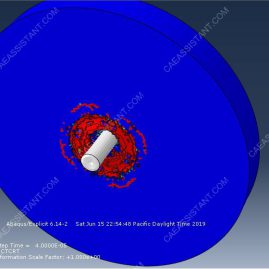
In this tutorial, the ballistic impact of a steel projectile on soda-lime glass is simulated in Abaqus to investigate damage behavior.
Glass is a complex material, and its modeling presents significant challenges. It is highly compressible and undergoes densification that increases with time, temperature, pressure, and applied shear. Pressure strongly influences its strength: higher pressures lead to higher strengths. Glass is also strain-rate sensitive, with flexural strength increasing as the loading rate rises. Its spall strength is high, and fracture begins once the elastic limit is exceeded under shock loading.
Scale effects are observed, where smaller samples are stronger than larger ones, consistent with the brittle nature of defect-containing materials. Glass also shows time-dependent inelastic deformation and strength loss during plate impact experiments.
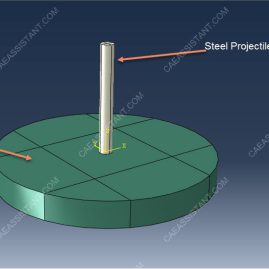
In the simulation, both the glass and projectile are modeled as three-dimensional parts. The projectile is defined as steel with elastic properties and Johnson-Cook plasticity, including rate dependence. For glass behavior under high-rate pressure loading, Abaqus provides suitable material models that can be defined through CAE, input files, or VUMAT subroutines. In this tutorial, the input file method is used to capture all aspects of glass behavior.
A dynamic explicit step with surface-to-surface contact is applied. Boundary conditions are fixed around the glass, and an initial velocity is assigned to the projectile. The mesh is refined at the impact location because brittle failure requires small element sizes for accurate prediction.
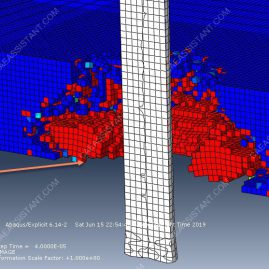
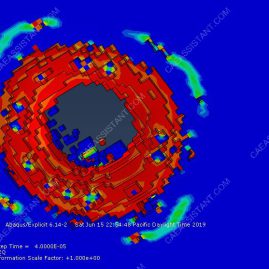
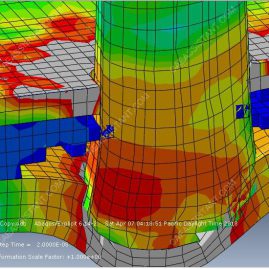
After the simulation, damage variables for the glass, along with stress, strain, and other results, can be extracted. Example results from this simulation are shown below.



Reviews
There are no reviews yet.