


The use of aluminum in automobile construction is increasing to reduce weight and improve fuel efficiency. This creates an important challenge: how to join aluminum parts efficiently, economically, and with reliable mechanical properties.
Several traditional welding methods are available, such as tungsten inert gas (TIG), metal arc welding (MIG), and resistance spot welding (RSW). These techniques require heating and melting of the aluminum alloy base metal. Other joining methods that avoid melting include self-piercing riveting (SPR), clinching, and bonding with structural adhesives.
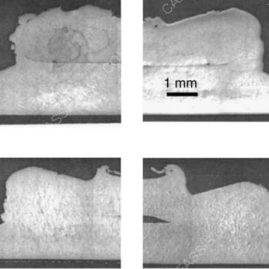
Spot Friction Stir Welding (SFW), also known as Friction Stir Spot Welding (FSSW), is a solid-state joining technique developed by Mazda Corporation and Kawasaki Heavy Industries in 2003. It is a variant of the linear Friction Stir Welding (FSW) process, which was invented by The Welding Institute (TWI) in 1991. Both FSW and SFW are promising processes for joining aluminum alloys in the automotive industry. They produce high-quality joints and allow welding of high-strength aluminum alloys with advantages in tensile strength, process time, and cost.
Studies show that aluminum sheets of different thicknesses can be joined using RSW, SPR, or SFW. The lap-shear strength of SFW joints is comparable to RSW and SPR. However, the process time for SFW increases with sheet thickness. Despite this, SFW offers several advantages: lower power consumption than RSW, reduced running costs, no weld spatter, longer tool life, high productivity, and improved reliability.
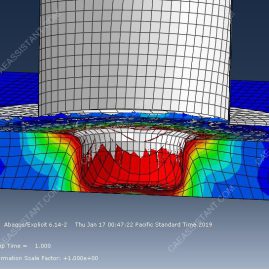
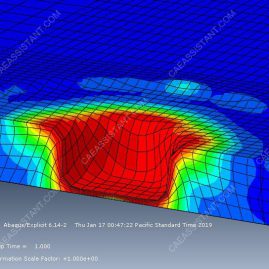
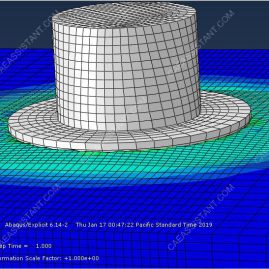
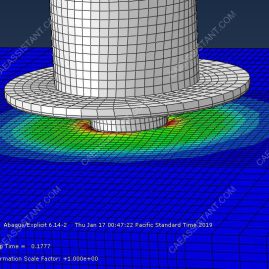
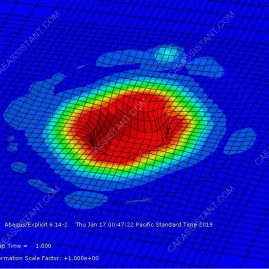
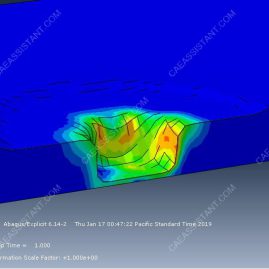
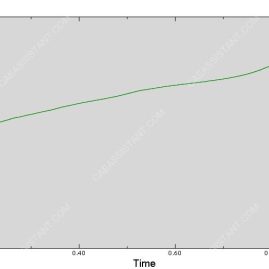
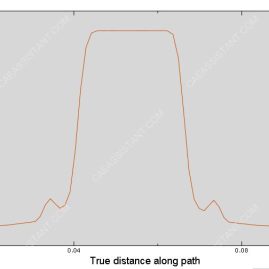
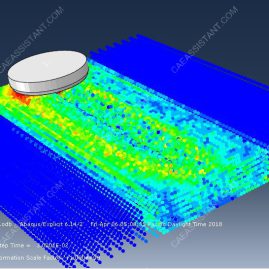
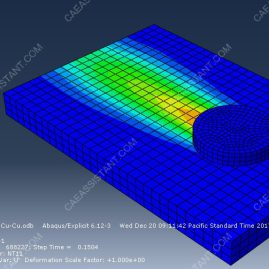
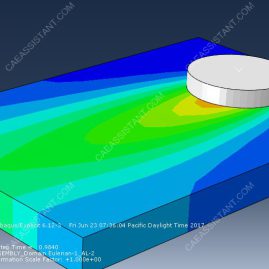
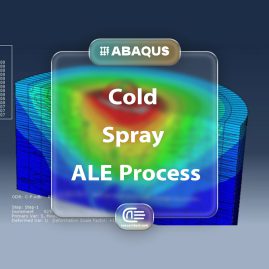
In this simulation, Friction Stir Spot Welding is analyzed using the Arbitrary Lagrangian–Eulerian (ALE) method in Abaqus. The aluminum alloy is modeled as the base material, while the tool is modeled as a rigid body. A dynamic explicit step is used, with modifications to include temperature effects. During the analysis, the rotating tool with axial velocity penetrates the aluminum plate. Stress distribution and temperature fields are observed, demonstrating the effectiveness of the ALE method in capturing the thermal–mechanical behavior of the process.
Reviews
There are no reviews yet.