


Most current finite element models of cutting focus on 2D plane strain orthogonal cutting. While this configuration is useful for studying fundamental cutting phenomena, it does not fully represent practical machining operations. In contrast, 3D models often simulate a 2D tool path with a curved cutting edge. The intermediate step—true 3D orthogonal cutting—is rarely addressed.
Due to its complexity and the many physical phenomena involved, orthogonal cutting is commonly used to simplify geometry and reduce the number of degrees of freedom in simulations. However, key coupled effects such as large strains, high strain rates, elevated temperatures, thermal gradients, and friction must still be considered. These challenges have led to many research publications.
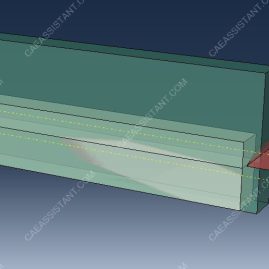
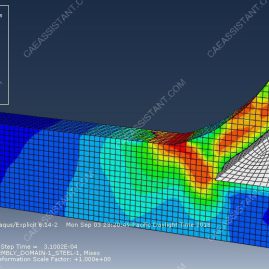
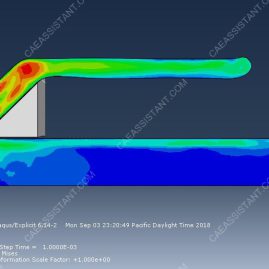
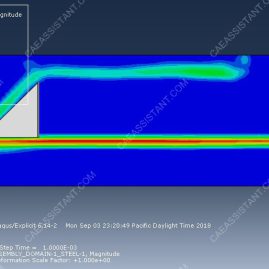
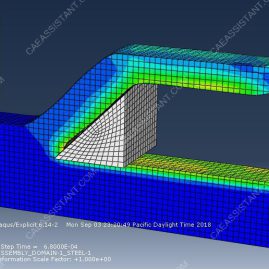
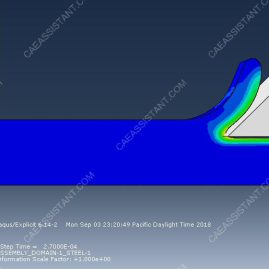
This tutorial introduces a 3D finite element model using the Coupled Eulerian-Lagrangian (CEL) formulation to simulate orthogonal cutting. The simulation shows the relative positions of the tool and workpiece throughout the process.
The Johnson-Cook constitutive model is used to describe the behavior of the Ti6Al4V titanium alloy workpiece. This model is well-suited for high strain-rate conditions and thermal effects. In this study, the temperature-dependent Johnson-Cook equation is applied.
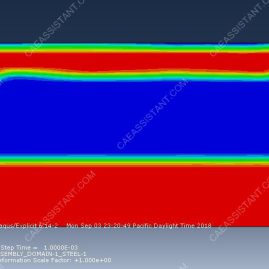
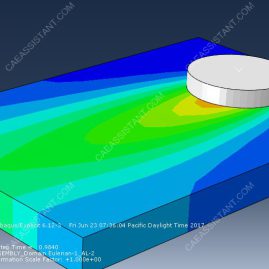
The simulation uses the Dynamic Temperature Explicit procedure, which is appropriate for this type of analysis. The Volume Fraction method defines the initial volume of the workpiece. Figures showing the results are provided below.




Reviews
There are no reviews yet.