


Insulated concrete sandwich panels consist of two outer concrete wythes and an inner layer of foam insulation. They are increasingly used because of their advantages such as light weight and energy efficiency. Different types of shear connectors can be applied to link the two concrete wythes. Recently, Fiber-Reinforced Polymer (FRP) shear connectors have gained attention, as they reduce thermal bridging and improve thermal performance.
Traditional Finite Element (FE) analysis often treats static and dynamic analyses separately. However, due to the flexibility of FRP shear connectors and the cracking behavior of concrete in insulated panels, nonlinear static models tend to diverge early, as shown in preliminary FE studies.
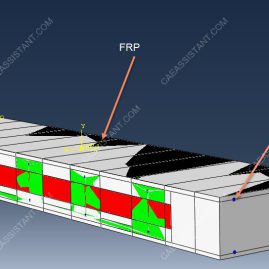
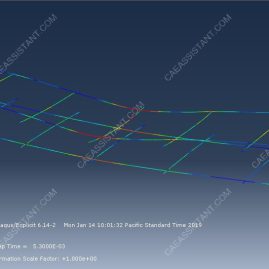
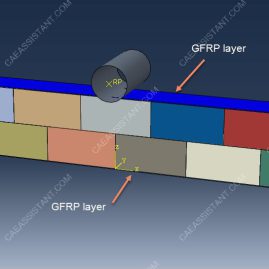
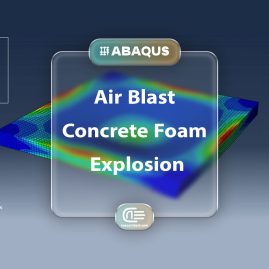
In this tutorial, blast analysis and damage investigation of insulated concrete sandwich panels are performed in Abaqus. Concrete and foam are modeled as three-dimensional solid parts. Beams are modeled as wire elements, and composites are modeled as shell parts. The following material models are applied:
Hashin’s damage criterion for composites
Johnson-Cook model for steel
Crushable foam data for foam
Johnson-Holmquist model for concrete
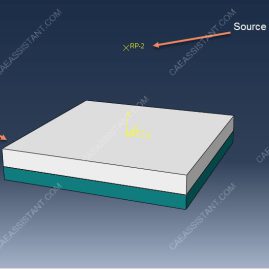
Dynamic Explicit analysis and the CONWEP air blast procedure are used, which are suitable for this type of simulation. The interaction between concrete, foam, and composite layers is modeled as perfect contact. Beams are embedded within the concrete part.
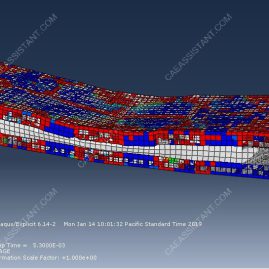
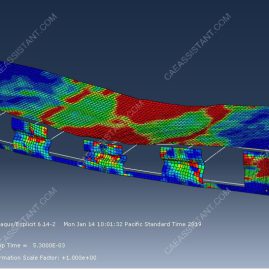
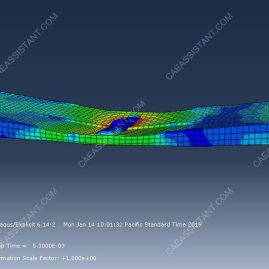
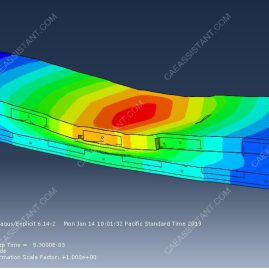
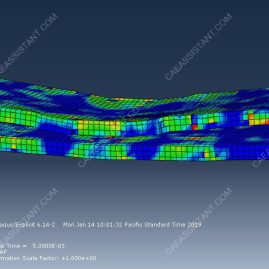
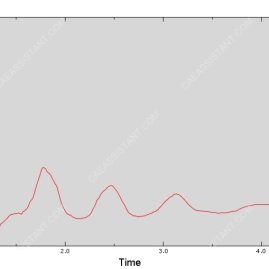
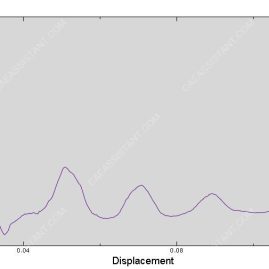
During the simulation, the concrete experienced large-scale damage. The middle section of the concrete was destroyed under the blast wave, while the foam layer was fully compacted. Damage in the composite layer was also clearly observed. Figures of the assembled parts and simulation results are provided below.
Reviews
There are no reviews yet.