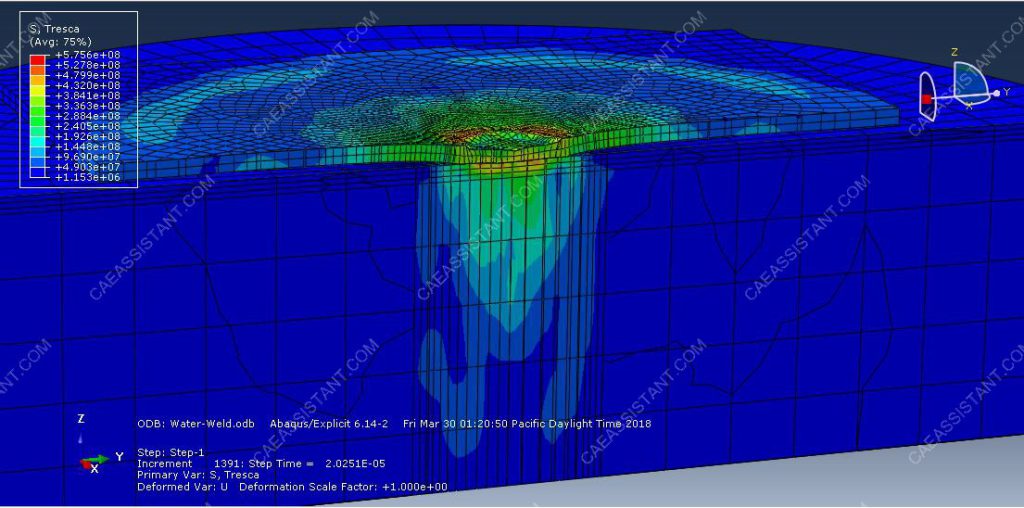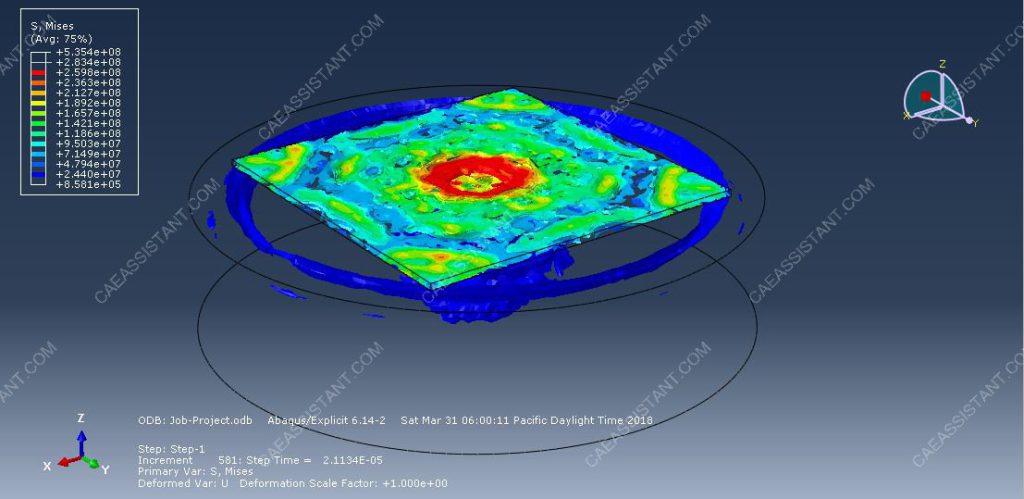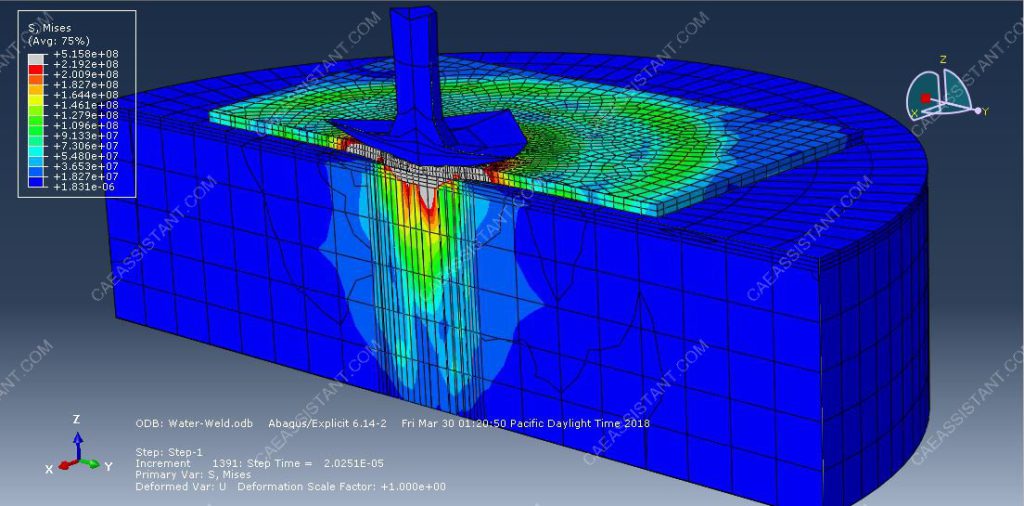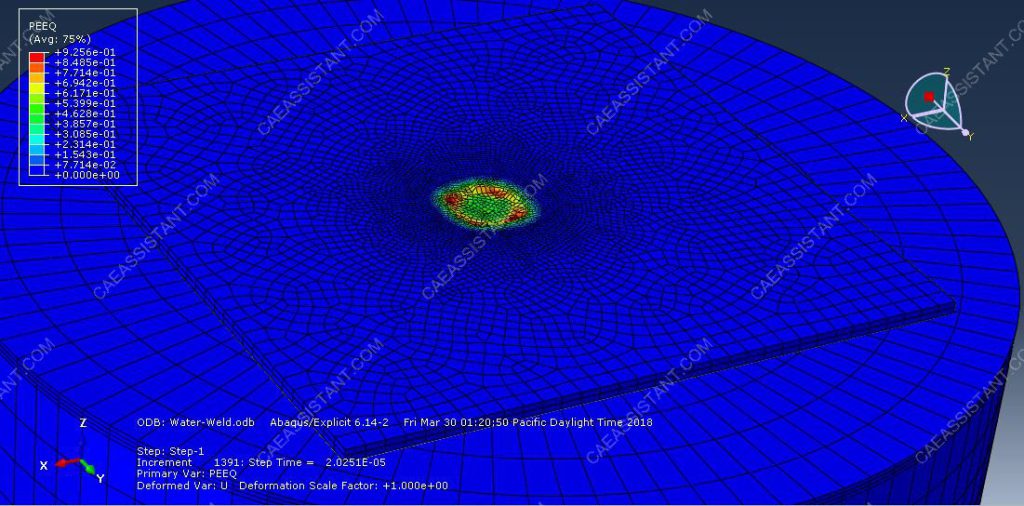

To understand the mechanism of material damage and removal during high-speed liquid impact, it is important to study the magnitude and spatial distribution of the transient pressures caused by such impacts on solid surfaces.
In this tutorial, water jet spot welding tests were performed using Abaqus software. The setup included a water column and a nozzle with a diameter of 4.2 mm. The target blocks were aluminium cladding plates, polished to dimensions of 50 mm × 50 mm × 1 mm. The separation distance between the target plate and the flyer plate was varied, with a minimum distance of 0.5 mm.
All parts were modeled as three-dimensional and deformable. To represent water behavior, the Us–Up equation and the Lagrangian method were applied. The aluminium plates were defined using the Johnson–Cook material model. For the analysis, the Dynamic-Temp Explicit procedure was chosen, with appropriate boundary conditions and interactions implemented.
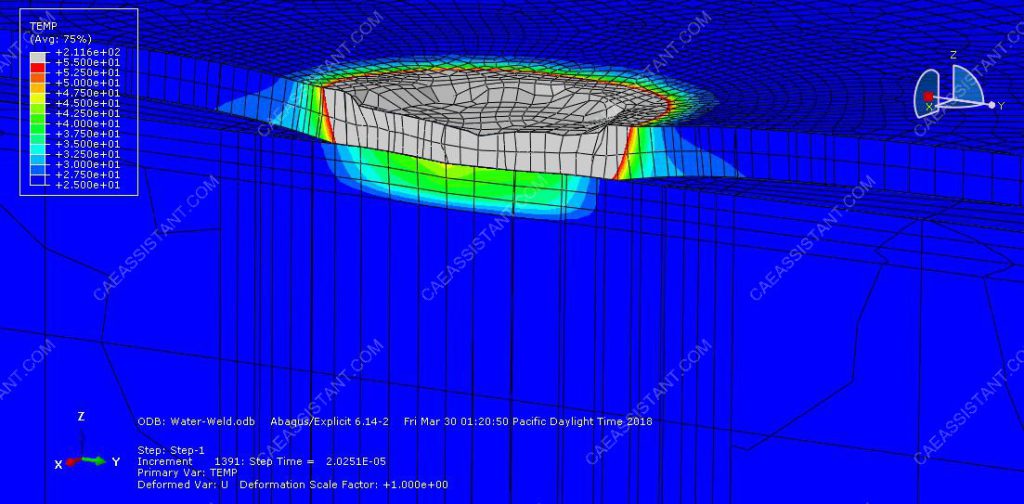
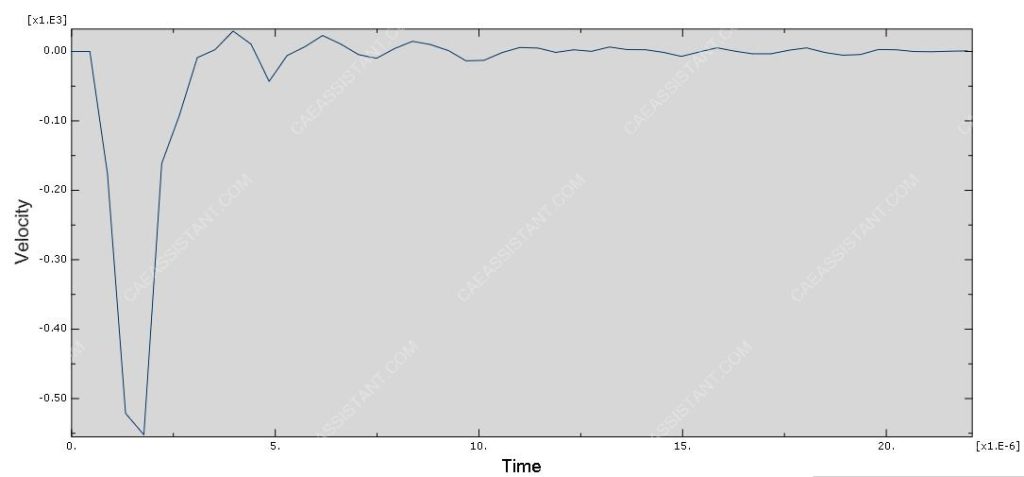
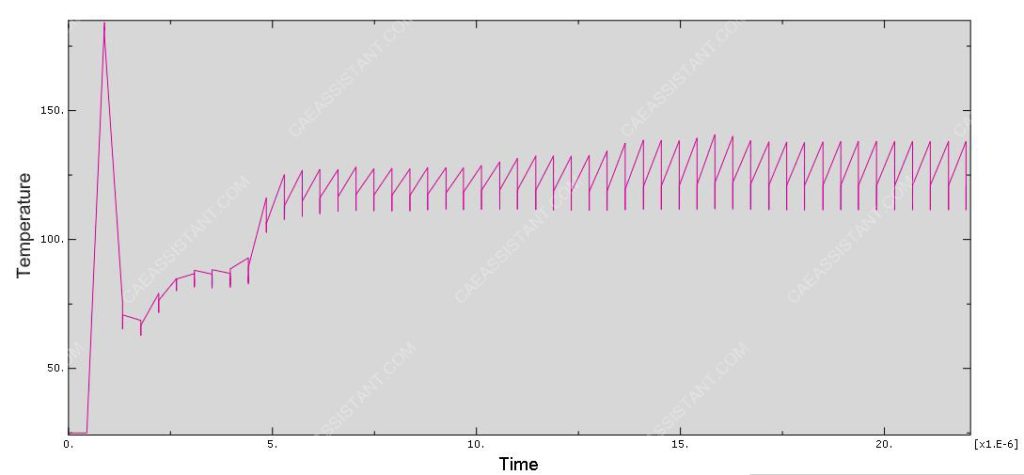
During the water jet impact, the flyer plate was driven toward the base plate. After contact, a small joint was formed between the two plates. Figures of the simulation results are shown below.