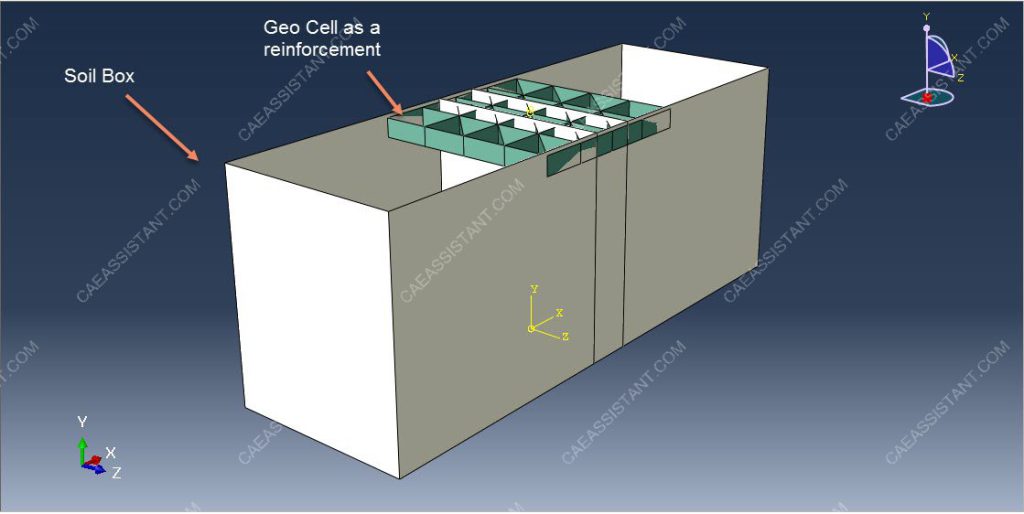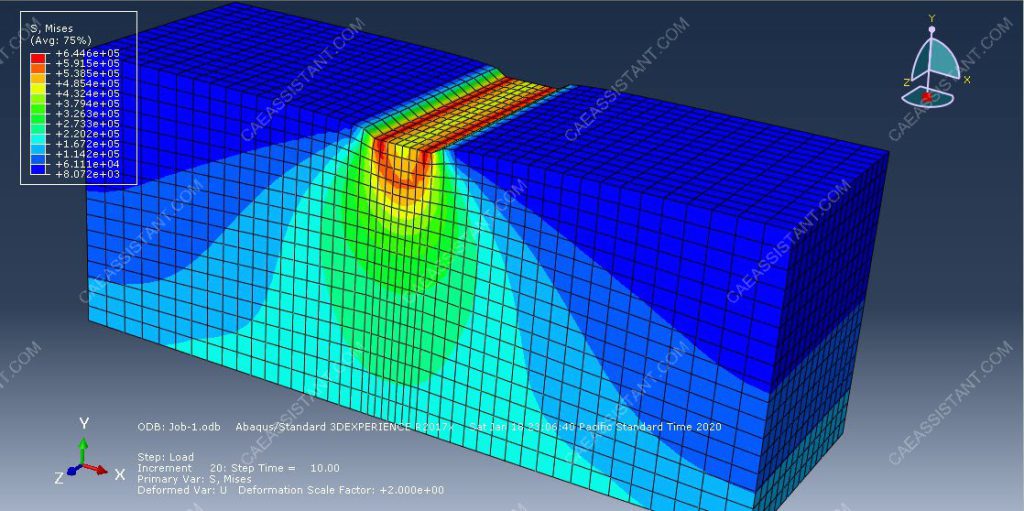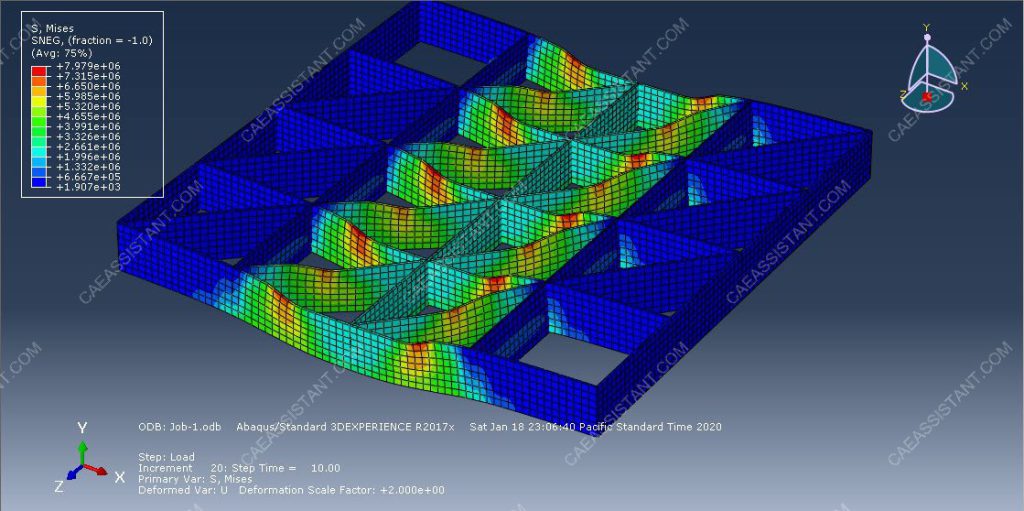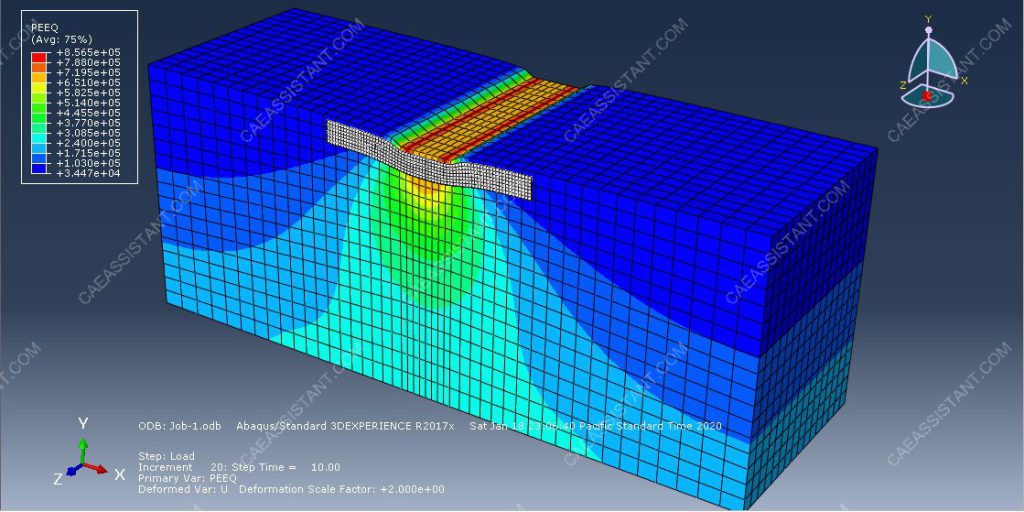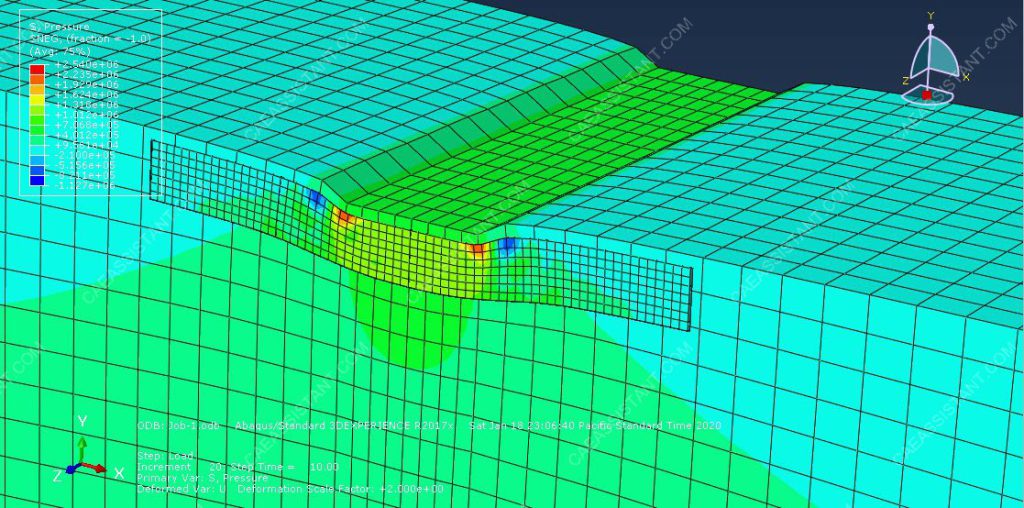
In this tutorial, the pressure distribution on subgrade soil beneath a geocell-reinforced foundation bed is studied using Abaqus. High contact stresses in foundation soil, caused by increased loads, often lead to distress, instability, and large settlements.
Today, geocell reinforcement is widely used to improve the performance of foundation beds. With the rise of high-rise structures, contact pressures on foundation soils have increased significantly, making soil improvement essential. Geosynthetic reinforcements provide a potential solution. Among them, geocell reinforcement is a modern technique that confines soil within three-dimensional pockets. This confinement increases the rigidity of the soil bed and enhances overall performance.
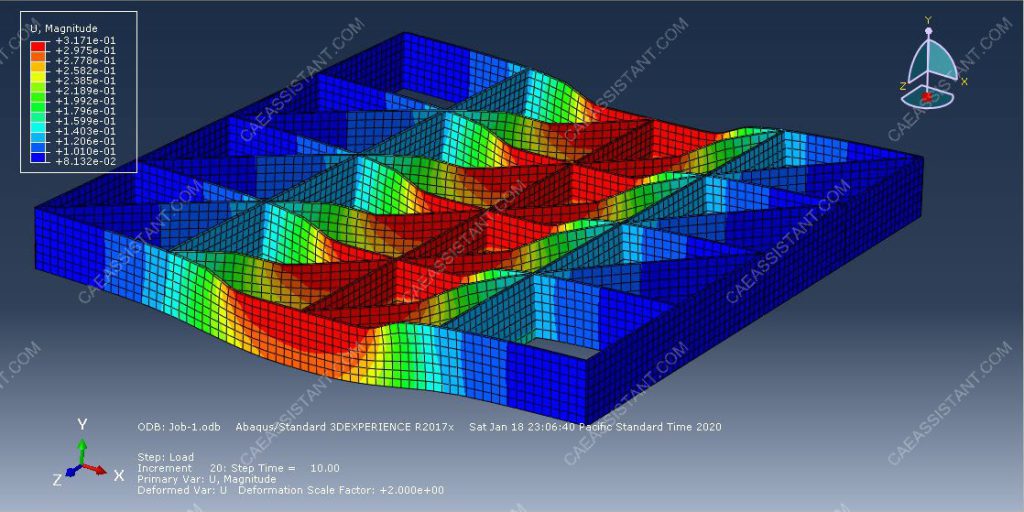
Commercial geocells are typically manufactured from high-density polyethylene sheets, welded ultrasonically into a honeycomb pattern. In the simulation, the soil is modeled as a three-dimensional solid part, while the geocell is modeled as a three-dimensional shell part.
- Material modeling:
- Geocell behavior: elastic data.
- Soil behavior: elastic data with Cap model plasticity and hardening.
- Simulation steps:
- Apply gravity to all parts and uniform pressure to the top surface of the soil.
- Apply a normal load on the footing zone using a velocity-type load.
The geocell part is embedded inside the concrete host. A fixed boundary condition is assigned to the bottom surface of the soil. A fine mesh is recommended to achieve accurate results.
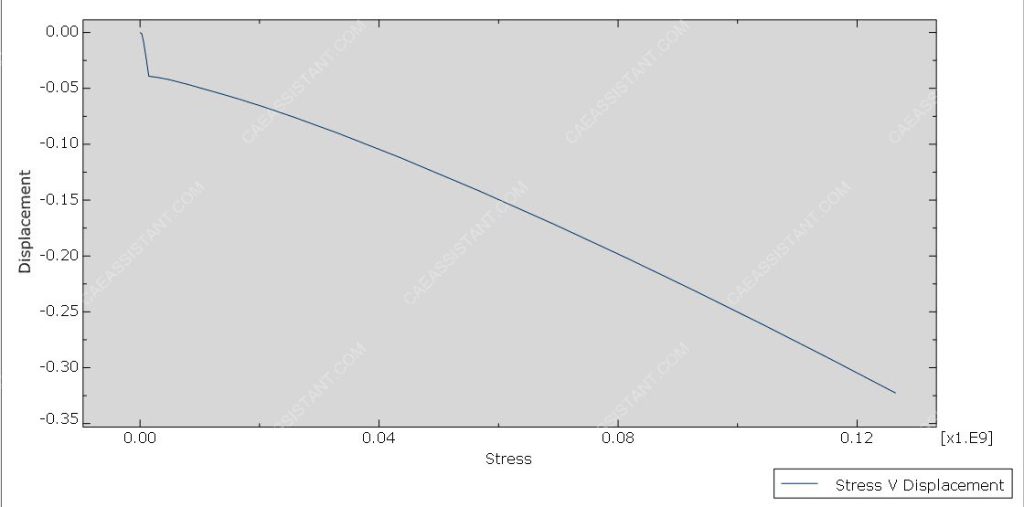
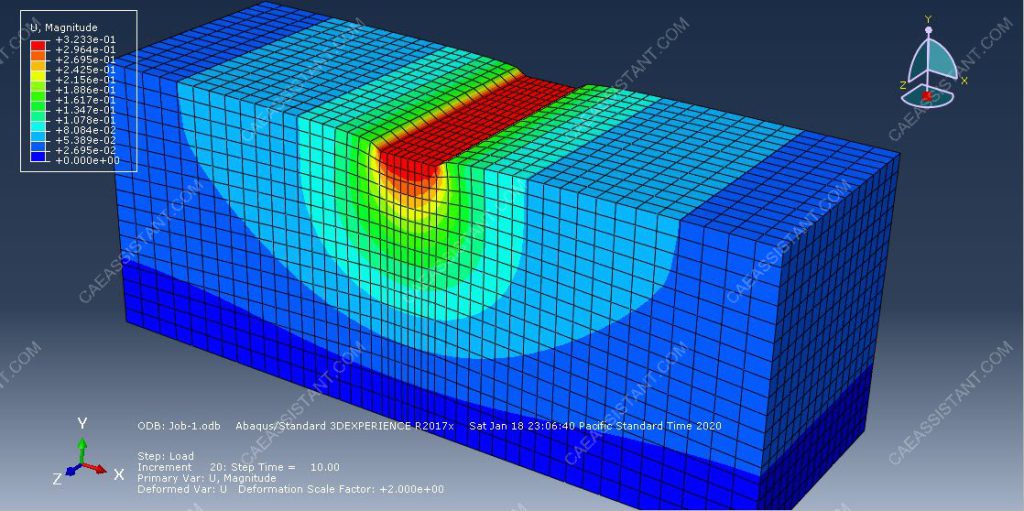
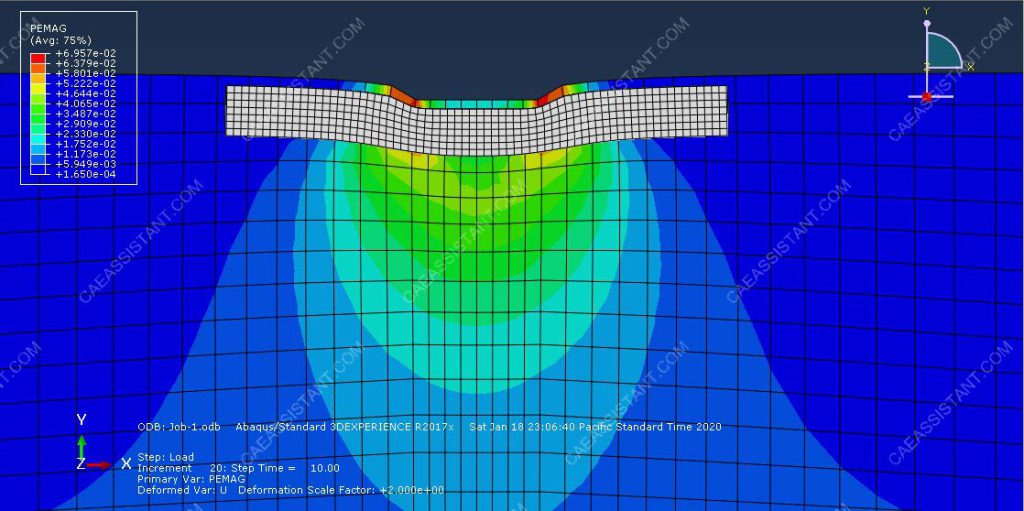
After the simulation, results such as stress, strain, displacement, and stress–settlement diagrams can be obtained. Figures of the assembled parts and results are shown below.