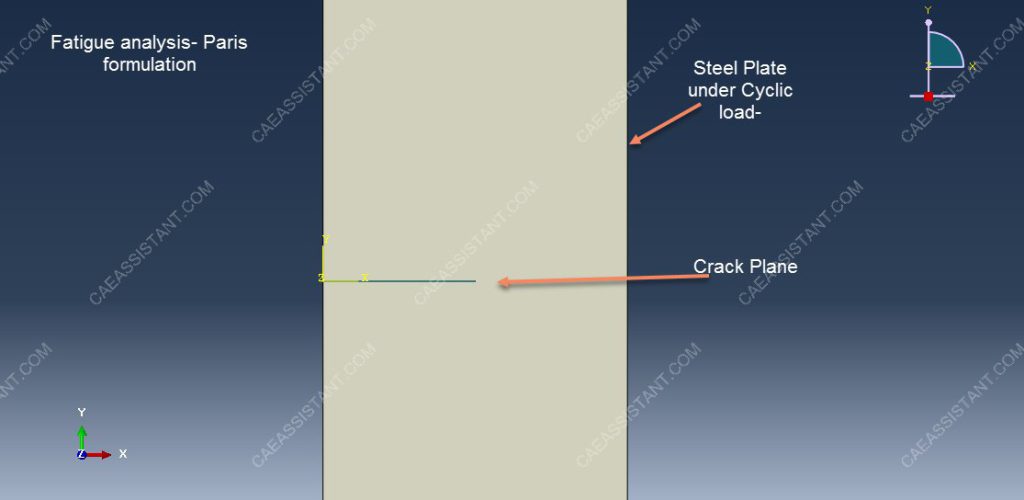
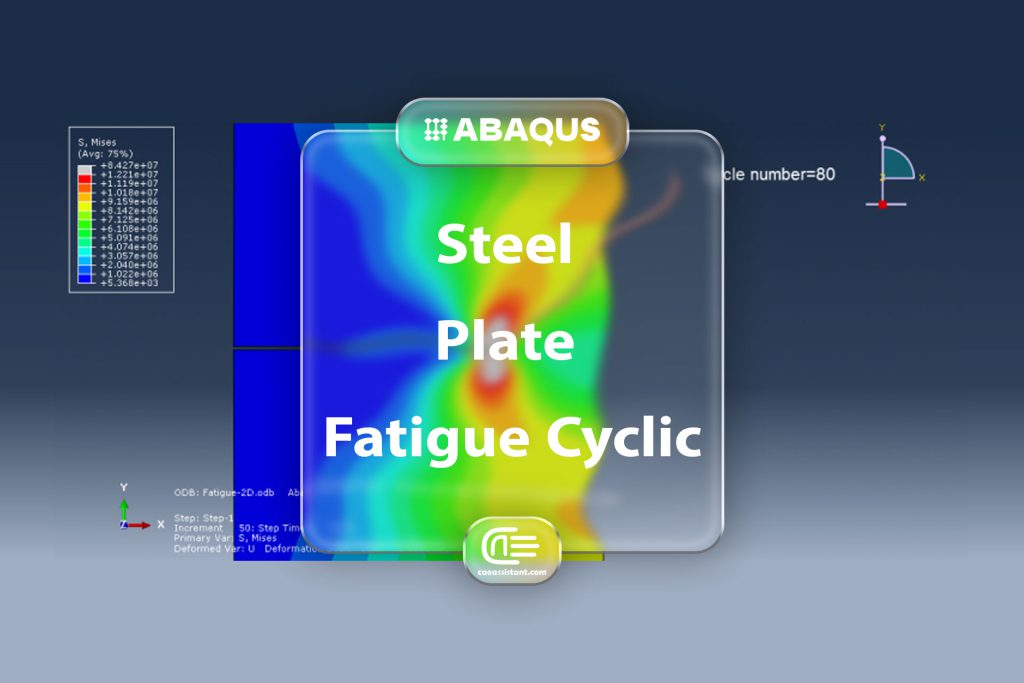
In this tutorial, the fatigue phenomenon of a steel plate is simulated in Abaqus using the Direct Cyclic Step. A two-dimensional steel part is modeled, along with a wire part to define the initial crack length. The material is considered elastic and coupled with a traction-separation law to capture fracture and crack growth in the plate.
When a structure is subjected to repetitive loading cycles, such as an automobile exhaust manifold exposed to temperature fluctuations and clamping loads, its stress–strain response may eventually stabilize. In this stabilized state, each cycle produces the same stress–strain relationship as the previous one.
The classical way to obtain this response is to apply the periodic loading repeatedly until stabilization occurs. However, this method is computationally expensive because many cycles may be required. To reduce cost, Abaqus provides Direct Cyclic Analysis, which calculates the cyclic response directly.
This method constructs a displacement function that describes the response of the structure at all times tt during a load cycle with period TT. A truncated Fourier series is used for this purpose, where nn is the number of Fourier terms, ω\omega is the angular frequency, and the unknown displacement coefficients are solved using a modified Newton method. The elastic stiffness matrix at the beginning of the step serves as the Jacobian.
The accuracy of the solution depends on the number of Fourier terms. More terms improve accuracy but increase computational cost. Since the goal is low-cycle fatigue prediction, the focus is on approximating the plastic strain cycle rather than exact stress values. Abaqus integrates the Fourier residual coefficients using the trapezoidal rule, which requires enough time points per cycle. If the number of Fourier coefficients exceeds the number of increments, Abaqus automatically reduces them for the next iteration.
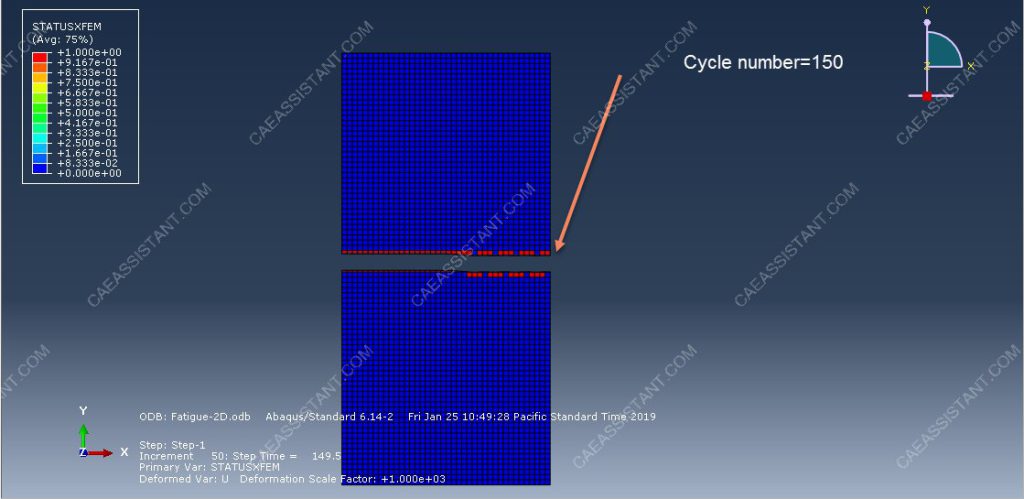
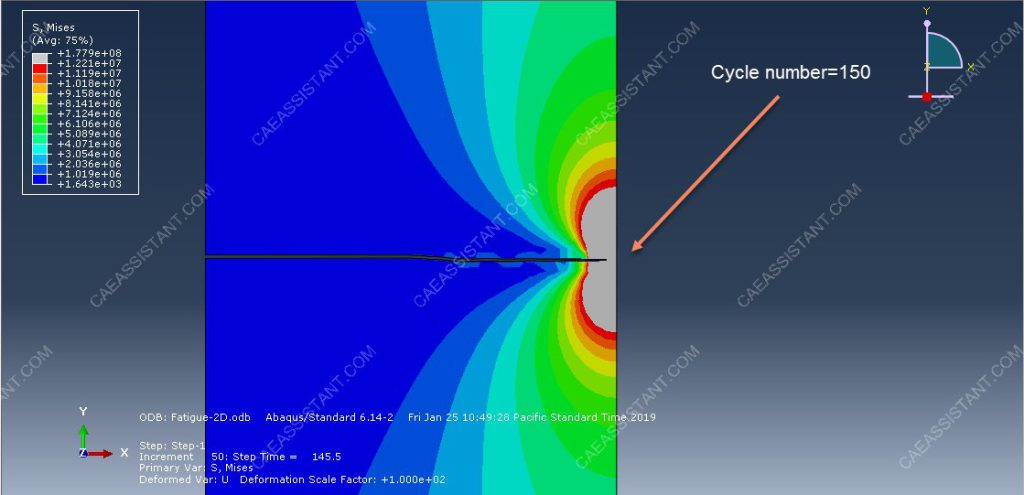
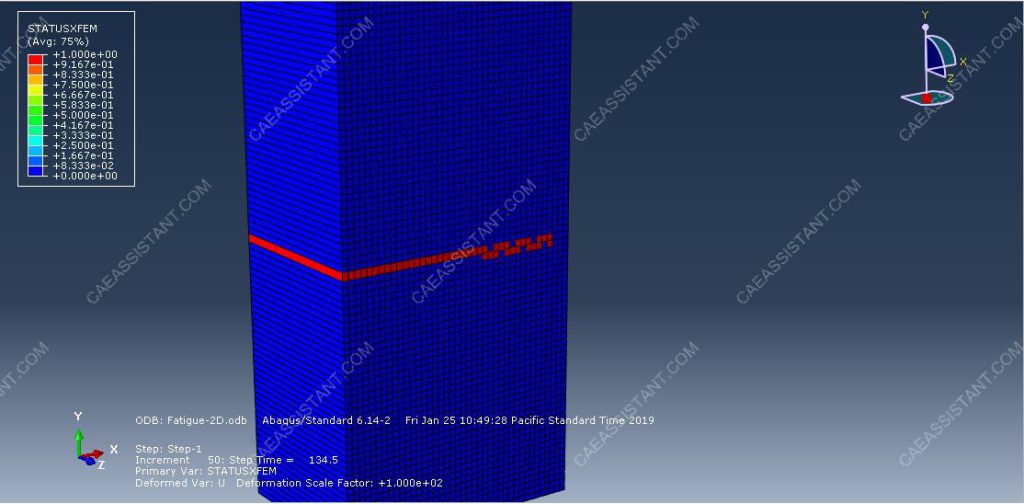
In this simulation, 150 cycles are applied. Crack growth is modeled using the Extended Finite Element Method (XFEM). Fatigue behavior is defined using the Paris Law combined with a power-law criterion.
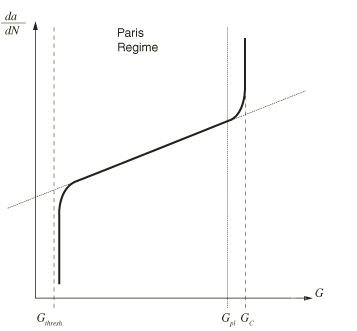
The Paris Law relates fracture energy release rates to crack growth rates. It is bounded by two limits:
- A threshold energy release rate, below which no fatigue crack growth occurs.
- An upper limit, above which crack growth accelerates.
The critical equivalent strain energy release rate is calculated based on the chosen mixed-mode criterion and the fracture strength of the material. Ratios of threshold and upper limits can be specified.
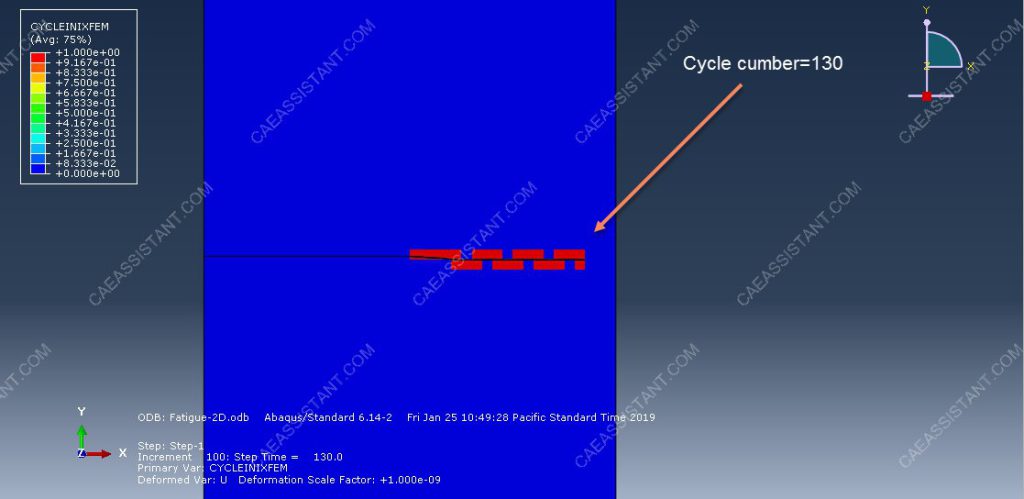
Fatigue crack growth begins at the crack tip in enriched elements once the initiation criterion is satisfied. This criterion depends on material constants and cycle number. If the maximum fracture energy release rate exceeds the threshold, crack growth occurs. The growth rate per cycle is then calculated using the Paris Law.
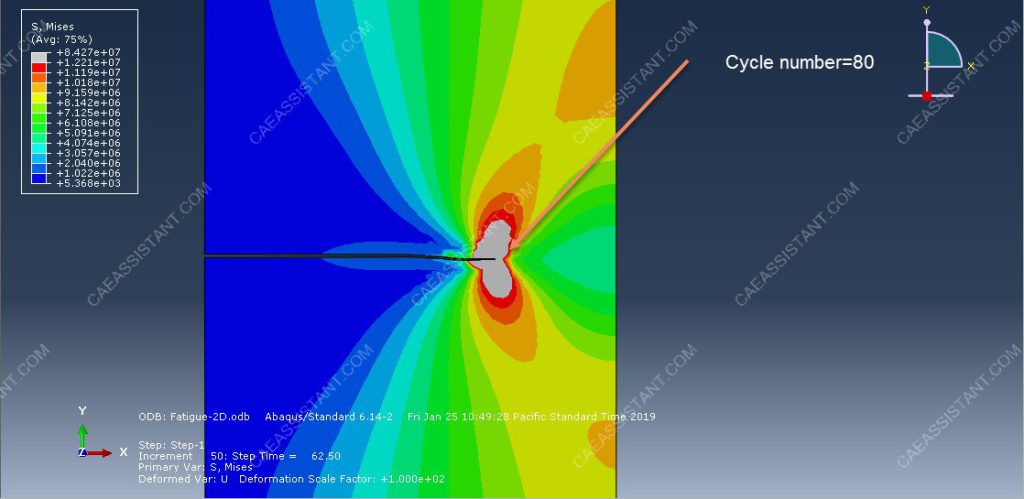
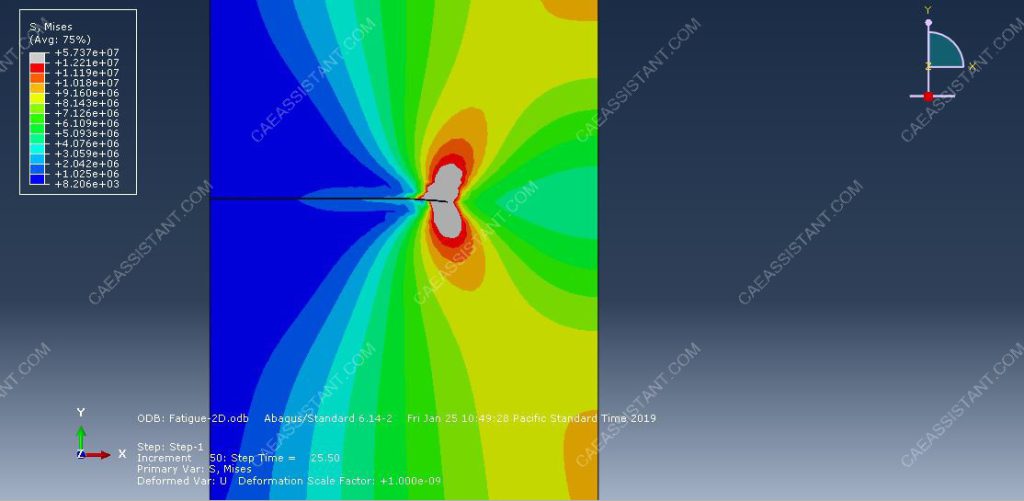
Figures of the assembled parts and simulation results are provided below.