


In this tutorial, the simulation of an air blast explosion on a composite panel (glass + PVB) in Abaqus is investigated. Explosions in air generate characteristic pressure–time signatures that propagate outward. When these pressure waves strike annealed glass, sharp fragments are formed, which can cause injuries.
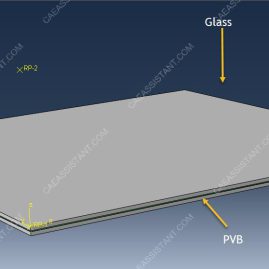
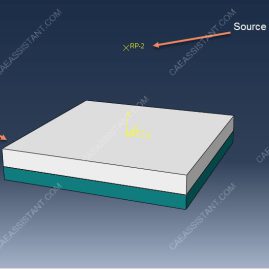
To reduce this risk, laminated glass is used. The interlayer keeps fragments adhered and deforms to absorb pressure loads. In the model, two solid and deformable glass layers are defined, with a PVB interlayer placed between them as a solid part.
To represent glass behavior under extreme loads such as blasts or high-velocity impacts, a suitable material model must be chosen. Abaqus provides several options through CAE, input files, and VUMAT subroutines. In this case, the input file capability is used to define a new material model for glass. For the PVB interlayer, elastic–plastic behavior is applied.
A dynamic explicit step is selected for the analysis. Mass scaling is used to reduce the stable time increment and overall simulation time. Perfect contact is assumed between the glass laminates and the PVB, while surface-to-surface contact with stiffness is also considered. The CONWEP procedure is employed to apply the blast load on the panel surface. Fixed and symmetry boundary conditions are assigned to the outer edges and symmetry planes of the model. A fine mesh is required to obtain accurate results.
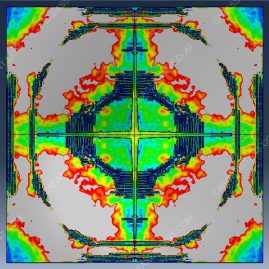
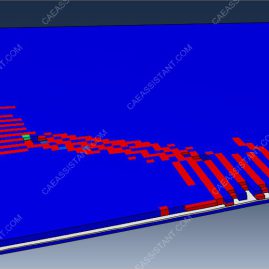
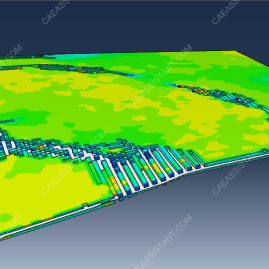
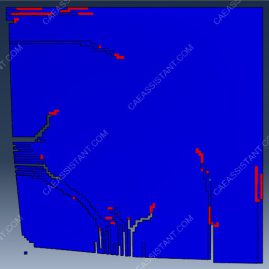
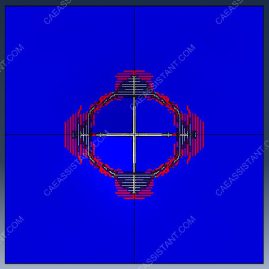
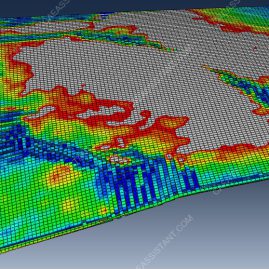
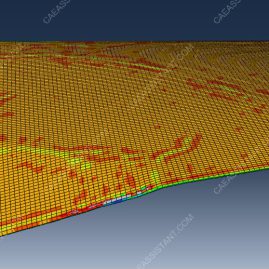
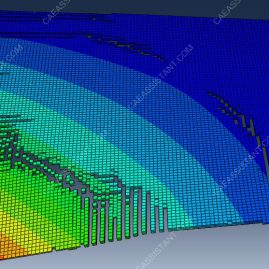
After the simulation, results such as stress, strain, damage, ductile damage, failure, and displacement are available. The two glass layers show complete failure, while the PVB interlayer undergoes large deformation during the blast event.
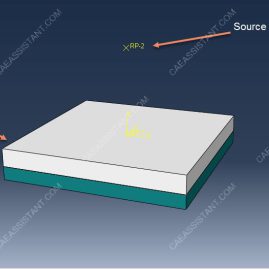
Figures of the assembled parts and simulation results are shown below.
Reviews
There are no reviews yet.