




With the increase in global security concerns, terrorist bombings and accidental explosions have become serious threats to critical infrastructure, including important economic, military, and civilian facilities. As a result, research on the blast resistance and safety of structures has gained significant attention.
To meet the growing demand for power, irrigation, and drinking water, many high dams are being constructed worldwide. Due to their major political and economic importance, these dams could become potential targets for terrorist attacks. The failure of a dam caused by an explosion could lead to severe economic losses, large-scale casualties, and extensive media coverage. Since the September 11 attacks, public concern about bomb threats to dam structures has increased considerably. Therefore, improving the blast protection of dams is a key aspect of national and homeland security.
Understanding the failure modes and anti-blast performance of concrete gravity dams under underwater explosions is essential for assessing their safety. However, the physical processes involved in underwater detonations and the resulting shock wave propagation are highly complex. The structural response of a dam subjected to such dynamic loading is much more complicated than that under static or seismic conditions.
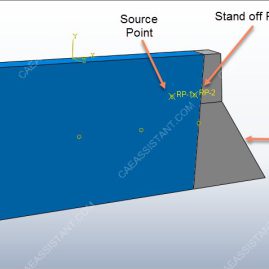
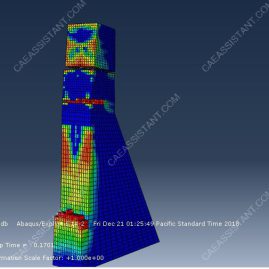
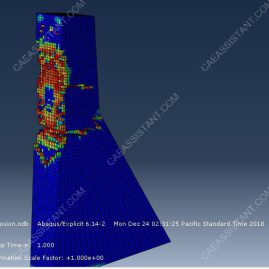
In this Abaqus simulation, three-dimensional models of the dam and surrounding water were created. To accurately represent the behavior of concrete under high strain rates and extreme stress, an appropriate damage-based material model was used. The simulation employed a dynamic explicit step with the UNDEX (Underwater Explosion) procedure.
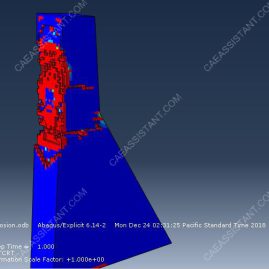
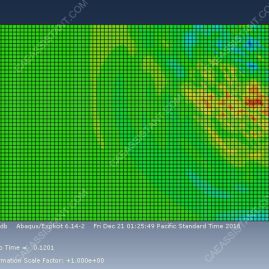
The results show the distribution of damage within the dam structure. The extent of damage varies depending on the amount of TNT used and the position of the explosive source. Several figures below illustrate the model setup, explosion locations, and resulting damage patterns observed in the simulation.
Reviews
There are no reviews yet.