


The use of a water wall around an explosive has proven to be an effective method for reducing the impact of shock waves and blast pressure during accidental explosions. When detonation occurs, the high-pressure shock wave aerosolizes the nearby water. This process causes a phase change in the water and redistributes both internal and kinetic energy among the detonation gases, the blast wave, and the barrier material.
Because of its effectiveness in attenuating explosions, the water mitigation concept is gaining attention in both defense and commercial applications, especially for the safe storage of energetic materials.
An explosion results from the sudden release of energy. After detonation, the solid explosive is transformed into gaseous products at extremely high pressures, sometimes exceeding hundreds of thousands of atmospheres. This pressure is converted into mechanical work through momentum transfer, forming pressure waves that propagate into the surrounding medium.
In this simulation, the pressure–volume–energy behavior of TNT detonation gases is modeled using the standard Jones–Wilkins–Lee (JWL) equation of state, with a detonation velocity of 6,930 m/s.
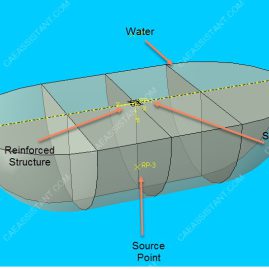
All parts in the model are defined as three-dimensional Eulerian domains. The water is represented using the Us–Up equation of state, while TNT is modeled with the JWL equation of state. A dynamic explicit procedure is applied, which is appropriate for this type of blast analysis.
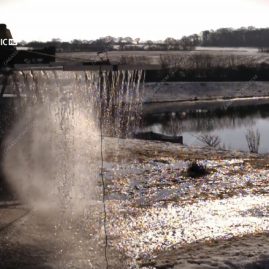
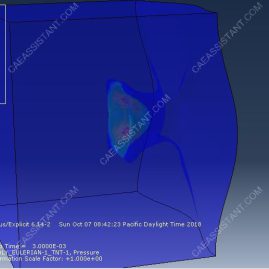
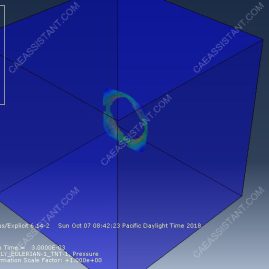
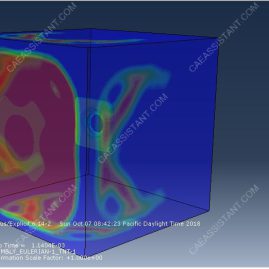
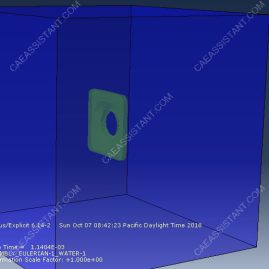
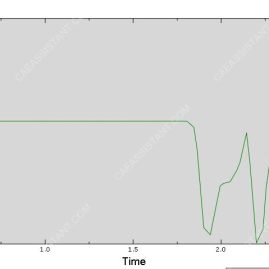
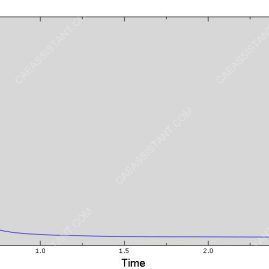
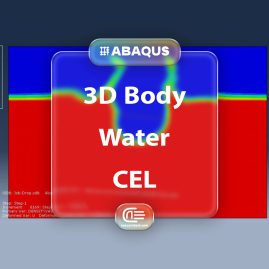
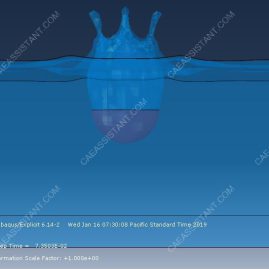
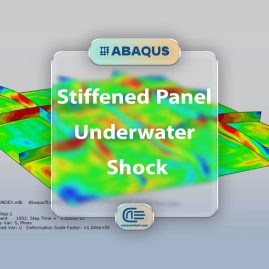
Figures of the experimental setup and simulation results are provided below.
Reviews
There are no reviews yet.